
IIFT International Business and Management Review Journal

1Institute of Economics and World Economy, Vietnam Academy of Social Sciences (VASS), Hanoi, Vietnam
2VNU International School, Vietnam National University, Hanoi, Vietnam
3Vietnam Institute for Real Estate Market Research and Evaluation (VARS-IRE), Vietnam Association of Realtors (VARS), Hanoi, Vietnam

Creative Commons Non Commercial CC BY-NC: This article is distributed under the terms of the Creative Commons Attribution-NonCommercial 4.0 License (http://www.creativecommons.org/licenses/by-nc/4.0/) which permits non-Commercial use, reproduction and distribution of the work without further permission provided the original work is attributed.
Why do four ASEAN middle-income economies—Malaysia, Thailand, Indonesia and the Philippines—pursuing comparably ambitious digital–green industrial strategies between 2018 and 2023 generate markedly divergent upgrading trajectories? This article argues that the explanatory variable lies not in policy content but in policy architecture: the institutional configuration through which industrial policy is translated from strategic vision into firm-level action. Two dimensions of architecture prove decisive: coordination quality, measuring the degree to which inter-ministerial mechanisms generate accountability for diffusion outcomes; and integration degree, measuring the extent to which digital and green transformation mandates are governed jointly rather than in parallel. Drawing on a structured focused comparison across four cases selected on a most-similar systems logic, the article derives a 2×2 typology—Integrated Coordinator (Malaysia), Selective Institutionaliser (Thailand), Ambitious Fragmentor (Indonesia) and Document-policy State (the Philippines)—whose predicted upgrading trajectories are confirmed by firm-level technology absorption data (World Bank Enterprise Surveys), economic complexity indices, manufacturing value-added per worker and green export intensity. The comparative analysis identifies two asymmetric failure modes: coordination failure produces stagnation, in which technology does not reach small and medium enterprises; integration failure produces incoherence, in which digital and green transitions pull firms in contradictory directions. The article situates Vietnam at Type III and derives a sequenced institutional reform pathway from comparative logic rather than generic prescriptions. The theoretical contribution is the introduction of policy architecture as a meso-level construct bridging the macro literature on mission-oriented industrial policy and the firm-level literature on absorptive capacity.
Industrial policy architecture, digital–green twin transition, technology diffusion, developmental state, ASEAN, comparative political economy, Vietnam
Introduction
Policy ambition is not policy outcome. This article takes the gap between the two seriously and asks why four ASEAN economies—Malaysia, Thailand, Indonesia and the Philippines—with broadly comparable levels of stated commitment to digital–green industrial transformation produced starkly divergent upgrading trajectories between 2015 and 2022. Malaysia advanced three places in the Economic Complexity Index (ECI) over this period; Indonesia fell eight. Malaysia’s manufacturing value-added per worker grew by 18.2%; Indonesia’s by 6.1%. Malaysia’s green export share reached 8.4%; Indonesia’s remained at 2.1%. The policy documents of all four governments invoke the same lexicon of mission-oriented industrial policy. The divergence lies elsewhere.
The standard explanations—differences in factor endowments, technology stocks or fiscal capacity—are analytically insufficient. Malaysia and Thailand both occupy the upper-middle-income band. Indonesia and the Philippines are lower-middle-income, yet the Philippines, with more explicit twin transition framing in its planning documents, underperforms Indonesia on most upgrading metrics. The gap in policy ambition, measured by the scope and number of strategy documents, approaches zero across all four cases. If the content of the policy does not explain the divergence, what does?
This article argues that the explanatory variable is policy architecture: the institutional configuration through which industrial policy is (a) translated from strategic vision into operational mandates, (b) coordinated across agencies with divergent interests, (c) transmitted to firms via institutional intermediaries and (d) adjusted based on outcome feedback. Policy architecture is distinct from policy design (which instruments exist), policy mix (how instruments combine at the portfolio level), and state capacity in the aggregate Skocpolian or Evansian sense. It is a meso-level construct: it sits above policy design and below general state capacity, bridging macro-level directionality and micro-level absorptive learning.
Two dimensions of architecture prove analytically decisive for the twin transition: coordination quality, which measures the degree to which inter-ministerial mechanisms generate accountability for cross-cutting diffusion outcomes; and integration degree, which measures whether digital and green mandates are governed jointly or run in parallel. The cross-tabulation of these two dimensions yields a 2×2 typology—Integrated Coordinator (Malaysia), Selective Institutionaliser (Thailand), Ambitious Fragmentor (Indonesia), and Document-policy State (the Philippines)—that not only classifies but predicts upgrading trajectories and does so by distinguishing two asymmetric failure modes: coordination failure generates stagnation; integration failure generates incoherence. These failures require different reform diagnoses.
The article proceeds as follows. The second section develops the theoretical framework, locating policy architecture between three intersecting literatures and operationalising its two dimensions. The third section presents the research design. The fourth section analyses the four cases through a common analytical template. The fifth section synthesises causal mechanisms and failure modes across cases. The sixth section applies the typology to Vietnam. The seventh section concludes with theoretical contributions and directions for future research.
Theoretical Framework and Conceptual Contribution
Three Literatures and the Meso Gap
The study of digital–green industrial transformation in middle-income economies sits at the intersection of three theoretical traditions, each of which illuminates a different facet of the puzzle without resolving it.
Mission-oriented industrial policy scholarship (Aiginger & Rodrik, 2020; Mazzucato, 2018; Rodrik, 2014) has recovered the analytical legitimacy of state-directed structural transformation, demonstrating that directionality—the state’s capacity to set and pursue societal goals—is an endogenous rather than exogenous variable. Yet this literature stops at mission-setting. The question of how missions traverse bureaucratic hierarchies, navigate inter-agency competition and reach firms with heterogeneous absorptive capacities remains underdeveloped (Larrue, 2021). Setting missions and achieving missions are analytically distinct problems, and the literature has a structural tendency to treat the latter as an extension of the former.
The developmental state tradition (Doner et al., 2005; Evans, 1995; Johnson, 1982; Wade, 1990) provides a vocabulary for implementation: embedded autonomy, pilot agencies, performance discipline and bureaucratic insulation. This tradition insists that inter-ministerial coordination capacity and firm-level monitoring are necessary conditions for industrial policy to generate structural transformation. However, it typically operates at the level of aggregate macro-institutional configurations—Ministry of International Trade and Industry (MITI)-like agencies, industrial development bureaus—and has not been systematically extended to the twin transition context, where the state must simultaneously coordinate digital and green mandates that recruit different professional communities, standards regimes and stakeholder coalitions.
Technology diffusion and absorptive capacity scholarship (Bell & Pavitt, 1993; Cohen & Levinthal, 1990; Lall, 1992) operates at the firm level. Its central contribution is that technology diffusion is not automatic: firms require absorptive capacity, developed through research and development (R&D) investment, skills formation and experiential learning, to appropriate externally available knowledge. Diffusion occurs through learning networks—value chains, multinational corporation (MNC)–small and medium enterprise (SME) linkages, technology intermediaries—rather than through price signals alone. What this literature leaves undertheorised is the role of the state’s institutional configuration in creating or suppressing those diffusion intermediaries: who funds them, who sets their key performance indicators (KPIs), who bears accountability for their reach.
The theoretical gap lies precisely at the intersection: how does the state, at a meso level between the macro of directionality and the micro of firm capability, organise itself to translate a mission into firm-level absorptive learning? Policy architecture is the construct that fills this gap.
Conceptual Definition and Boundaries
Policy architecture is defined here as the institutional configuration through which an industrial policy is (a) translated from strategic vision into specific operational mandates, (b) coordinated across agencies with divergent mandates and interests, (c) transmitted to firms via institutional intermediaries, and (d) evaluated and adjusted on the basis of outcome data. This definition comprises four constituent functions: translation, coordination, transmission and feedback. Any policy architecture must perform all four; the analytical question is which institutional mechanisms perform them and with what quality.
The concept is delimited from three related but distinct constructs. Policy design refers to what policies exist—the instrument portfolio, priority sectors, specific incentive structures—and is analogous to building materials rather than architecture. Policy mix (Flanagan et al., 2011) describes how instruments combine at the portfolio level but says little about the governance that allows the portfolio to function. State capacity in the Skocpolian or Fukuyaman sense is a national aggregate-high or low-that does not specify the configuration deployed for a particular transformation challenge (Skocpol, 1985; Fukuyama, 2013). A country may have high general state capacity but weak policy architecture for a specific mandate, or vice versa: Thailand’s general state capacity is moderate, yet its Bio-Circular-Green (BCG) Economy architecture is relatively strong for a middle-income ASEAN economy. Policy architecture is thus a specific configuration, not a summary statistic.
Two Analytical Dimensions
Two of the four functions are analytically decisive for the twin transition: coordination and integration. Translation and feedback are important but conditional on the prior two: good translation without coordination produces fragmentation; good feedback without integration only monitors separate trajectories.
Coordination quality (Dimension A) measures the degree to which state agencies with divergent mandates are organised to act coherently towards shared industrial transformation goals. Four sub-indicators are operationalised: (A1) the existence and executive authority of a dedicated inter-ministerial coordinating body; (A2) cross-ministry budget mechanisms (shared funding pools or co-financing); (A3) performance accountability systems with agency-level KPIs linked to upgrading outcomes; (A4) formal policy agility mechanisms allowing adjustment based on outcome data. Each indicator is scored 0–2 (2 = mechanism exists with documented implementation; 1 = mechanism exists on paper without documented implementation; 0 = absent), yielding a total 0–8 scale classified as low (<4) or high (.png) 4).
4).
The logic is as follows. Without coordination, agencies optimise for narrow mandates: the Ministry of Industry targets output growth; the Ministry of Environment targets emission standards; the Ministry of Information and Communications targets digital coverage. Without a mechanism that generates accountability for cross-cutting diffusion outcomes, technology intermediaries lack a single accountable stakeholder. SMEs receive contradictory signals from competing programmes and face prohibitive compliance costs. Coordination quality reduces these frictions and generates coherent demand for diffusion infrastructure—a demand driven not by markets but by institutional accountability pressure.
Integration degree (Dimension B) measures the extent to which digital and green transformation policies are governed jointly rather than in parallel. Four sub-indicators: (B1) a shared governance body with an explicit mandate spanning both transitions; (B2) joint budget lines or co-financing for digital–green programmes; (B3) cross-policy conditionality (digital investment incentives conditioned on green requirements, or vice versa); (B4) integrated firm-level measurement capturing both digital and green outcomes simultaneously. Same 0–8 scale, classified as parallel (<4) or integrated (4).
The logic rests on a basic empirical observation: in production practice, digital transformation and green transition are not separate investment decisions but two dimensions of the same capital commitment. A new production line simultaneously alters energy intensity (green dimension) and automation level (digital dimension). When the state governs these dimensions through separate frameworks, firms receive contradictory signals. Cross-policy conditionality—requiring digital applicants to disclose energy efficiency baselines or conditioning green incentives on digital capability requirements—forces coherence at the design stage and compels firms to integrate both considerations in investment decisions. This mechanism has no clear analogue in single-transition industrial policies and represents a distinctive analytical feature of the twin transition context. Table 1 summarises the resulting 2×2 policy architecture typology derived from the two analytical dimensions.
Table 1. Policy Architecture Typology (2×2).

The 2×2 Typology and Predicted Trajectories
Each type carries a distinct predicted upgrading trajectory. Type I generates coherent multi-dimensional upgrading because architecture creates coherent demand for diffusion infrastructure, and firms receive consistent policy signals across both transitions. Type II generates medium-high upgrading with a bifurcated profile: strong in one dimension (typically green), weak in the other, with few firms achieving simultaneous improvement. Type III generates a dual economy: leading firms (typically foreign direct investment [FDI]-linked) upgrade through market channels while SMEs stagnate under fragmented coordination. Type IV produces a policy-outcome gap: ambitious planning documents without diffusion infrastructure result in upgrading confined to large and foreign firms accessible through market channels alone.
Two asymmetric failure modes follow. Coordination failure (characteristic of Type III) produces stagnation: technology does not reach the mass of firms. Integration failure (characteristic of Type II) produces incoherence: digital advances do not reinforce green outcomes, and the two transition pathways pull firms in contradictory directions. These are distinct failure modes that require distinct reform diagnoses, a distinction absent in existing comparative analyses of the twin transition.
Research Design and Methodology
Structured Focused Comparison
The article applies structured focused comparison (George & Bennett, 2005): all cases are analysed through the same standardised template derived from the theoretical framework, permitting systematic cross-case comparison without requiring statistical generalisation. This design is analytically appropriate for three reasons. First, N = 4 renders statistical analysis both technically inapplicable and scientifically inappropriate for the causal question posed. Second, the article’s interest is in how architecture generates diffusion outcomes (mechanism), not merely whether a relationship exists (correlation)—a question suited to process-tracing and structured comparison rather than regression. Third, heterogeneity across cases is treated as analytically informative rather than as noise.
Case Selection: Most-similar Systems with Variation
on the Independent Variable
The four cases are selected on a most-similar systems logic (Przeworski & Teune, 1970), maximising similarity on potential confounders while maximising variation on the independent variable. Table 2 reports the case selection criteria used to justify the most-similar systems comparison. Table 3 presents the composite upgrading indicators used to compare the four ASEAN cases.
Table 2. Case Selection Criteria.
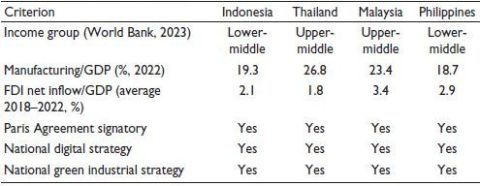
Source: UNCTAD (2023), United Nations Industrial Development Organization (2023), World Bank (2023).
Table 3. Upgrading Composite.

Source Harvard Growth Lab (2023), United Nations Industrial Development Organization (2023), WBES (2019/2022), WTO (2022).
Variation on the independent variable is substantial. Malaysia scores 7 on coordination quality and 6 on integration (Type I); Thailand scores 5 and 2 (Type II); Indonesia 3 and 3 (Type III); the Philippines 2 and 2 (Type IV). Singapore is excluded as a small open city-state with gross national income (GNI) per capita exceeding $65,000 and an industrial policy logic incomparable to the four selected cases. Vietnam is treated as an implication target rather than a comparative case to avoid circular logic. Cambodia, Myanmar, Laos and Brunei are excluded on grounds of pre-industrialisation status or resource-economy logic.
Operationalising Industrial Upgrading
The dependent variable—industrial upgrading—is operationalised as a composite of four indicators, each independently sourced. Economic complexity trajectory (Harvard Growth Lab Atlas, 2015-2022 ECI rank change) captures productive knowledge embedded in export structure, grounded in the economic complexity literature (Hidalgo & Hausmann, 2009; Hausmann et al., 2014). Manufacturing value-added per worker growth (UNIDO Industrial Statistics, constant 2015 USD) captures the productivity dimension of upgrading. Green export intensity (World Trade Organization [WTO] Environmental Goods Agreement data + OECD TiVA) captures the green dimension, critical for validating the integration argument. Technology absorption at the firm level (World Bank Enterprise Surveys [WBES] 2019/2022, share of firms using foreign-licensed technology) captures the mid-step in the causal chain between architecture and aggregate upgrading.
Comparative Analysis
Malaysia: Type I—Integrated Coordinator
Malaysia’s National Industrial Master Plan 2030 (NIMP 2030, September 2023) structures industrial ambition through four missions, two of which—digital vibrancy and net zero manufacturing—are governed jointly under a single MITI-chaired Steering Committee with cross-ministry membership including Finance, Science and Technology, Energy and Environment. The prior Malaysia Digital Economy Blueprint (MyDIGITAL, 2021) is explicitly linked to NIMP’s digital mission, creating policy continuity rather than duplication.
Coordination scores 7/8. A National Digital Economy and 4IR Council, chaired by the Prime Minister, operates alongside the NIMP Steering Committee, with overlapping membership that creates vertical and horizontal coherence. A dedicated Strategic Change Management Office tracks implementation. The RM 95 billion 7-year budget features explicit cross-ministry allocation mechanisms. Mission-specific KPIs with annual reporting requirements are publicly committed, including firm participation counts and energy intensity targets.
Integration scores 6/8. The most analytically novel mechanism is cross-policy conditionality: applicants for the Smart Factory Incentive must meet energy efficiency disclosure requirements; recipients of the Investment Tax Allowance must submit a net-zero pathway plan. The World Bank Malaysia Economic Monitor (2023) identifies this as an instrument without analogue in other ASEAN economies. Its significance is that it forces firms to attend simultaneously to both transitions rather than treating them as sequentially separate decisions.
Diffusion infrastructure density is exceptionally high: MDEC, MIDA, MIGHT, 15 Industry4WRD assessment centres and IndustryConnect sectoral hubs operate under a common accountability architecture. Industry4WRD data (MDEC Annual Report, 2022) document 2,400+ firms assessed and 847 SMEs completing upgrade programmes with an average productivity gain of 14%. Manufacturing emission intensity fell 7.3% between 2018 and 2022, consistent with the cross-policy conditionality mechanism. WBES: 31.4% of firms use foreign-licensed technology—the highest of the four cases.
Three political economy constraints warrant acknowledgement without invalidating the Type I classification. Bumiputera preference requirements create tension with meritocratic SME selection in innovation programmes. Government-linked corporations with vested interests in specific energy technologies generate policy capture risk in the green transition. Federal-state implementation friction produces variation in programme reach across industrial states. Type I does not mean frictionless; it means architectural mechanisms exist to manage frictions.
Thailand: Type II—Selective Institutionaliser
Thailand organises industrial ambition through two strong but parallel frameworks. The BCG (elevated to National Agenda 2021) targets four strategic domains—agri-food, bio-materials, bio-energy and creative tourism—through a National BCG Board chaired by the Prime Minister. Thailand 4.0 and subsequent digital programmes (Digital Economy Promotion Agency [DEPA], BOI Digital Incentive) target manufacturing digitalisation. These frameworks share no governance structure, no joint budget lines and no cross-policy conditionality. The separation is deliberate, not accidental.
Coordination scores 5/8: strong within each domain, absent across domains. BCG has dedicated institutional infrastructure, including NSTDA, a BCG Loan Facility of 150 billion baht, and annual progress reporting. The Digital Economy and Society Council operates comparably for the digital domain. Neither body has a mandate over the other.
Integration scores 2/8: no shared governance body, no cross-policy conditionality, no integrated measurement. Sub-programme overlap exists (digital agriculture within BCG), but it is incidental rather than systemic.
The political economy of this design is instructive. BCG benefits primarily agri-food sectors associated with provincial political coalitions; Thailand 4.0 digital programmes benefit urban-manufacturing districts with different political alignments. The institutional separation of the two frameworks reflects a coalition management logic rather than a technocratic design error. BCG was institutionalised more robustly precisely because it served the political interests supporting the 2014–2023 military-backed government (Stockholm Environment Institute, 2022).
Firm-level evidence confirms the bifurcated upgrading prediction. BOI digital incentive recipients improved digital adoption rates, but energy intensity increased 4.8% between 2018 and 2022. BCG Heroes programme participants (approximately 300 firms) improved green compliance metrics but showed no significant digital adoption gains. Upgrading is real but incoherent: the two transitions advance separately. WBES: 26.8% technology absorption rate.
Indonesia: Type III—Ambitious Fragmentor
Making Indonesia 4.0 (2018) targets the digital transformation of five priority industries with presidential endorsement and explicit medium-term plan integration. A concurrent nickel-to-EV industrial policy (2020–) leverages the nickel export ban and intensive incentives for domestic battery manufacturing. Both fall nominally under the Ministry of Industry (Kemenperin) but operate through separate institutional logics and coordinate with entirely different inter-ministerial bodies.
Coordination scores 3/8: PIDI 4.0 (Indonesia Industry Digital Centre) constitutes a diffusion intermediary, but no inter-ministerial body with executive authority spans multiple ministries. A Coordination Committee for Manufacturing 4.0 exists on paper but lacks a dedicated secretariat and meets infrequently. EV policy is coordinated through the Coordinating Ministry of Maritime and Investment Affairs—a separate architecture. Agency-level KPIs for upgrading outcomes are absent; INDI 4.0 assessments measure firm readiness rather than ministerial coordination accountability.
Integration scores 3/8: No shared governance body spans digital and green mandates. The EV policy represents a sector-specific integration attempt—battery production requires both digital manufacturing capability and green emission credentials—but this is isolated rather than generalised as cross-policy conditionality across sectors.
The political economy of Type III architecture in Indonesia reflects structural conditions rather than mere policy failure. Post-1998 decentralisation distributed authority across 38 provinces and 514 districts, creating coordination friction that no single ministry can overcome without a presidential-level directive. Turf competition between Kemenperin, the Coordinating Ministry and the Ministry of Environment is a permanent structural feature. The nickel export ban, moreover, serves rent-seeking interests of mining conglomerates connected to political elites more than it advances SME upgrading downstream—a constellation of interests structurally hostile to coherent cross-cutting policy architecture.
INDI 4.0 Assessment 2022: 67.3% of 1,215 surveyed firms score below 2.0/5.0 (pre-readiness level). WBES: 18.7% technology absorption—the lowest of the four cases. Manufacturing energy intensity increased 3.2% between 2018 and 2022 (International Energy Agency, 2023), precisely the digital-without-green contradiction predicted for integration failure. The 17 PIDI 4.0 lighthouse sites function as demonstration facilities rather than system-wide diffusion engines; accountability pressure to scale is absent.
Philippines: Type IV—Document-policy State
The Philippines articulates the most comprehensive twin transition framing of the four cases. The Philippine Development Plan 2023–2028 explicitly embeds digital economy, green and blue economy, and science-based manufacturing under an eight-point transformative agenda. AmBisyon Natin 2040 provides a long-run visioning framework. On documentary evidence, the Philippines rivals Malaysia in formal ambition. The gap lies in the implementation infrastructure.
Coordination scores 2/8: The National Economic and Development Authority (NEDA) serves as the institutional locus for PDP but functions primarily as a planning body rather than an implementation overseer. The Inter-Agency Council for Trade and Industry exists but has a broad mandate and low meeting frequency. Agency-level KPIs for twin transition outcomes are absent; PDP carries national-level indicators not disaggregated to ministerial accountability. Policy adjustment follows political cycles (non-renewable 6-year presidencies) rather than institutional feedback loops.
Integration scores 2/8: DTI, DICT, DENR, DOE and DOST operate independently. Joint budget lines for twin transition programmes do not exist. Cross-policy conditionality is absent. Measurement systems are separate.
The explanation lies substantially in structural fiscal constraint. Public investment as a share of GDP stands at 5.6% (2022), against Malaysia’s 8.2% and Thailand’s 7.1%. This is not merely a political preference but a structural condition rooted in post-Marcos fiscal austerity and the revenue-sharing provisions of the 1991 Local Government Code. Six-year non-renewable presidencies compound the problem by incentivising programme rebranding with each administration rather than institutional accumulation. The Philippines is not a case of failed political will; it is a case in which structural fiscal constraints and political cycle dynamics prevent the conversion of planning ambition into implementation architecture.
Negosyo Centers provide business advisory services through more than 1,000 outlets nationwide, but their mandate covers registration and basic advisory—not technology transfer. No equivalent of Industry4WRD assessment exists at scale. WBES: 22.1% technology absorption, 61% of firms citing workforce skills as a major constraint (highest of the four cases). The manufacturing share of GDP declined from 24% (2000) to 18.7% (2022)—the only case exhibiting deindustrialisation.
Cross-case Synthesis: Causal Mechanisms and Failure Modes
Coordination Quality Predicts Diffusion Infrastructure Density
Across the four cases, a consistent pattern emerges: countries with high coordination quality (Malaysia = 7, Thailand = 5) maintain significantly denser diffusion infrastructure than countries with low coordination (Indonesia = 3, Philippines = 2). The mechanism is institutional accountability: when inter-ministerial bodies carry performance accountability for upgrading outcomes, agencies face incentives to expand diffusion intermediaries because programme participation rates provide the most visible evidence of institutional performance. In Malaysia, the NIMP Steering Committee requires quarterly reporting on Industry4WRD participation; MITI consequently has structural incentives to open additional assessment centres and push MNCs to formalise SME supplier linkages. In Indonesia, PIDI 4.0 operates as a demonstration facility without equivalent accountability pressure to scale. Thailand’s high coordination quality in the BCG domain generates dense diffusion infrastructure for green-bio industries; its absence in the digital manufacturing domain leaves digital diffusion sparser.
This pattern confirms Proposition 1: coordination quality predicts technology diffusion density, controlling for initial industrial base and FDI stock. It also establishes that coordination is necessary but not sufficient—Thailand’s bifurcated profile demonstrates that strong within-domain coordination without cross-domain integration does not produce coherent upgrading.
Integration Degree Predicts Coherent Upgrading Trajectories
Countries with high integration scores produce coherent upgrading trajectories: advances in digital complexity do not contradict green performance. Malaysia’s cross-policy conditionality—requiring Smart Factory applicants to meet energy efficiency disclosure—compels firms digitising production to simultaneously address the green dimension. The result is one of the few documented cases in Southeast Asia where manufacturing energy intensity declined in parallel with increased digital adoption. Indonesia’s integration failure is comparably precise: Making 4.0 carries no green conditionality, and manufacturing energy intensity increased 3.2% between 2018 and 2022 while digital adoption expanded in targeted sectors. Thailand’s bifurcated profile—BCG sectors greener but not more digital; manufacturing sectors more digital but not greener—is precisely what integration failure predicts: coherent within domains, incoherent across them.
This confirms Proposition 3: absent integration, digital advancement does not reinforce green outcomes, producing a long-run coherence failure. The distinction between coordination failure (stagnation) and integration failure (incoherence) is asymmetric and practically important: a government misdiagnosing integration failure as coordination failure will expand inter-ministerial bodies without introducing conditionality mechanisms, and vice versa. Correct diagnosis is a precondition of correct reform.
The Political Economy of Architecture Choice
The typology raises a second-order question: why do countries choose the architectures they do? Four political economy variables explain architecture choice across the four cases.
Coalition structure conditions coordination capacity. Malaysia’s historically dominant coalition enables top-down cross-ministerial mandates. Indonesia’s post-1998 pluralist coalition politics require presidential bargaining with multiple partisan and regional interests, making cross-ministerial authority difficult to construct and sustain. The Philippines’ multi-faction presidentialism and 6-year administrative cycles structurally resist institutional accumulation.
The federal–unitary axis conditions the feasibility of centralised conditionality. Indonesia’s post-2001 decentralisation distributes significant authority to provinces and districts, generating implementation friction that NIMP-style cross-ministry conditionality cannot easily overcome. Malaysia’s federal structure retains sufficient central authority for MITI to impose national industrial mandates. Thailand’s unitary structure provides vertical authority, but strong regional political coalitions explain the selective institutionalisation of BCG for rural sectors versus digital programmes for urban manufacturing districts.
Fiscal centralisation conditions the feasibility of shared budget pools. Malaysia’s centralised fiscal authority under the Ministry of Finance, supplemented by Petronas revenues, enables the RM 95 billion NIMP budget with cross-ministry allocation. The Philippines’ fragmented fiscal system—divided between national agencies and local governments under the 1991 Local Government Code—structurally prevents shared funding for twin transition programmes.
These political economy findings have direct implications for Vietnam: a dominant-party unitary state with relatively centralised fiscal authority and high bureaucratic continuity across policy cycles presents more favourable structural conditions for Type I/II architecture than either Indonesia or the Philippines. The constraint is state-owned enterprise (SOE) dominance in strategic sectors, which generates vested interests in resisting cross-policy conditionality in energy-intensive industries.
The Causal Chain
The comparative evidence supports a causal chain running from political economy conditions through architecture choice to diffusion infrastructure density to SME absorptive capacity to industrial upgrading outcomes. The chain breaks at specific nodes. Coordination failure (Types III, IV) severs the link between architecture and diffusion infrastructure: without accountability pressure, intermediaries are not created or scaled. Integration failure (Types II, IV) severs the link between digital adoption and green outcomes: without conditionality, the two transitions advance separately and eventually contradict. Combined failure (Type IV) produces policy without diffusion: planning documents do not generate transmission mechanisms. The chain holds in Malaysia because all four links are reinforced by architectural mechanisms and supported by compatible political economy conditions.
When coordination and integration are both high (Type I), a multiplicative rather than additive effect obtains: coherent demand for diffusion infrastructure is generated across both transitions simultaneously, and institutional accountability for joint outcomes creates a positive feedback loop. This is a theoretical claim derived from the comparative evidence: Type II + Type III architectures do not approximate Type I outcomes.
Vietnam: From Type III to Viable Reform Pathway
Positioning Vietnam in the Typology
Applying the eight-indicator framework to Vietnam places it at Type III: Ambitious Fragmentor. The evidence is consistent. On ambition: the National Digital Transformation Program (Decision 749/Q.png) -TTg, 2020), the National Green Growth Strategy 2021–2030 (Decision 1658/Q-TTg, 2021) and the COP26 net-zero commitment (2050 target) place Vietnam at documented ambition levels comparable to Indonesia.
-TTg, 2020), the National Green Growth Strategy 2021–2030 (Decision 1658/Q-TTg, 2021) and the COP26 net-zero commitment (2050 target) place Vietnam at documented ambition levels comparable to Indonesia.
On coordination: digital transformation is governed primarily through the Ministry of Information and Communications (MIC) under the National Digital Transformation Program. Green industrial policy is governed through the Ministry of Natural Resources and Environment (MoNRE) and the Ministry of Industry and Trade (MoIT). The National Digital Transformation Steering Committee, chaired by the Prime Minister, constitutes an institutional asset, but its explicit mandate covers digital transformation, not green industrial transformation. No inter-ministerial body carries a joint mandate spanning both transitions. Coordination quality scores approximately 3–4/8.
On integration: no cross-policy conditionality exists between digital investment incentives and green requirements. Enterprise digital transformation support programmes (through the National Innovation Centre and the Enterprise Development Agency) carry no energy efficiency disclosure requirements. Green industrial programmes carry no digital capability requirements. The Just Energy Transition Partnership (JETP) commitment of $15.5 billion (2022) generates a forced integration point—grid digitalisation is technically required for energy transition—but JETP implementation is not governed by a dedicated inter-ministerial architecture. Integration degree scores approximately 2–3/8.
Vietnam’s firm-level profile mirrors Indonesia’s: WBES Vietnam 2022 shows 16.2% of firms using foreign-licensed technology; 63% cite workforce skills as a major constraint. The Type III classification is confirmed by multiple evidence streams.
The Indonesia Warning and the Thailand Pathway
Vietnam must treat the Indonesian trajectory as a plausible baseline absent architectural reform. After 6 years at Type III (since Making Indonesia 4.0 in 2018), Indonesia shows ECI decline of eight places, manufacturing energy intensity increase despite digital push, SME stagnation alongside FDI-linked firm upgrading, and a widening digital–green contradiction. Vietnam’s structural parallels are significant: SOE dominance in strategic industries, FDI-led manufacturing in export sectors, a large SME sector with low absorptive capacity and an emerging digital–green contradiction (data centre expansion without green energy mandates; rapid 2015–2020 coal expansion contradicting JETP commitments).
Thailand’s move towards Type II, by contrast, demonstrates an achievable institutional pathway. Thailand’s BCG institutionalisation was accomplished incrementally over 5 years (2018–2023) without major fiscal outlay—primarily institutional reconfiguration rather than new spending. Vietnam’s fiscal position (public debt approximately 37% of GDP, 2023) can support comparable reforms without fiscal stress. The key institutional moves are replicable: Prime Ministerial commitment with a dedicated board; cross-ministry secretariat; mission-specific programmes with measurable targets; public outcome reporting creating accountability without strong enforcement.
A Three-phase Reform Sequence
A sequenced reform pathway can be derived from the comparative logic rather than from generic prescriptions. Sequencing matters: coordination foundation must precede integration deepening because without accountability pressure, cross-policy conditionality creates a compliance burden without matching diffusion infrastructure.
Phase 1 (Years 1–2): Coordination Foundation. Expand the mandate of the National Digital Transformation Steering Committee to cover green industrial transformation explicitly; appoint a Deputy Prime Minister as standing chair of the enlarged committee; establish a joint secretariat within the Ministry of Planning and Investment (MPI) with staff seconded from MIC, MoIT and MoNRE; develop an integrated digital–green upgrading dashboard establishing baseline data; pilot cross-policy conditionality in the existing Enterprise Digitalization Support Program. MPI is the appropriate secretariat host because its cross-sector planning mandate is less threatening to other ministries than MIC (associated with digital mandate) or MoIT (associated with industrial mandate).
Phase 2 (Years 2–4): Diffusion Infrastructure Densification. Upgrade 50 Industrial Support Centres with explicit dual digital–green mandates and appropriately skilled staff; launch a targeted programme for 300 SMEs in electronics components, textile upgrading and food processing with intensive support and measurable outcome tracking; introduce an MNC–SME linkage requirement for foreign investors above $50 million committing to documented technology transfer plans; extend an INDI 4.0-style assessment incorporating the green dimension to 5,000 manufacturing firms.
Phase 3 (Years 4–7): Integration Deepening. Introduce full cross-policy conditionality: all industrial investment incentives conditioned on green performance disclosure. Develop a mandatory integrated digital–green scorecard for firms above 200 employees. Evaluate architecture performance against upgrading indicators and adjust based on feedback. Vietnam’s party-state system has demonstrated top-down coordination capacity in comparable reform contexts—provincial competitiveness reform, COVID response, digital banking transformation—which suggests that Phase 1 and Phase 2 are politically feasible within the current governance configuration.
The principal institutional resistance points are predictable. Turf competition between MIC, MoIT and MoNRE will complicate mandate expansion; designating MPI as the secretariat host rather than any of the three principal ministries is a neutralising move. SOE interests in energy-intensive sectors will resist cross-policy conditionality; sequencing conditionality to apply to new investment incentives before existing operations—graduated application rather than retroactive imposition—is the appropriate mitigation. Provincial competition for FDI may resist national green standards; developing a Provincial Twin Transition Readiness Index that aligns provincial competition with the national mandate, rather than contradicting it, converts a resistance mechanism into an alignment mechanism.
Discussion and Conclusion
Theoretical Contributions
This article makes three-layered contributions to comparative political economy and industrial policy scholarship.
Conceptually, it introduces and operationalises policy architecture as a meso-level construct with two measurable dimensions: coordination quality and digital–green integration degree. This construct fills the gap between mission-oriented industrial policy literature operating at the macro level of directionality and absorptive capacity literature operating at the firm level of technology adoption. Policy architecture is the mechanism through which state capacity is converted into policy outcome—a mechanism that the developmental state tradition describes at the level of aggregate institutions but does not operationalise for twin transition contexts.
Typologically, the 2×2 classification of Integrated Coordinator, Selective Institutionaliser, Ambitious Fragmentor and Document-policy State provides a falsifiable, predictive and generalisable analytical tool. The typology is falsifiable: a future study demonstrating that Type III countries systematically outperform Type I countries on upgrading metrics with comparable policy ambition would challenge the theory. Its boundary conditions are explicit: the typology applies to middle-income economies with significant manufacturing bases and active industrial policy involving both digital and green mandates. Its applicability to natural resource economies, pre-industrial economies or high-income economies is untested.
Causally, the identification of two asymmetric failure modes—coordination failure producing stagnation, integration failure producing incoherence—carries direct analytical and practical significance. These failure modes require different reform diagnoses: the former calls for inter-ministerial coordination mechanisms; the latter calls for cross-policy conditionality and shared governance. Misdiagnosing one as the other produces reforms that fail to address the binding constraint. This distinction is absent in existing comparative analyses of the twin transition, which typically treat institutional weakness as homogeneous.
The political economy of architecture choice constitutes a secondary contribution: architecture is not a pure technocratic choice but reflects coalition structure, federal–unitary configuration, party system competition and fiscal centralisation. This endogenisation of architecture choice moves the typology from descriptive classification towards causal explanation of why countries arrive at their institutional configurations.
Limitations and Directions for Future Research
The study’s limitations are acknowledged. Pattern identification across N = 4 cannot establish statistical regularity; the analysis supports conditional causal inference rather than universal claims. Future research should test the typology against additional middle-income manufacturing economies—Vietnam itself, through longitudinal tracking, Bangladesh, Morocco and Ethiopia—to assess generalisability and identify scope conditions not anticipated by the present analysis.
Measurement limitations constrain the analysis. Green export intensity data involve definitional debates about what constitutes environmental goods. The ECI captures export structure complexity but does not directly measure firm-level capability change. Firm-level panel data linked to policy participation records—unavailable for all four cases at comparable granularity—would allow direct testing of the diffusion mechanism.
The political economy of architecture choice is addressed qualitatively (Section ‘The Political Economy of Architecture Choice’) but not formally modelled. Why some middle-income states select Type I architectures while others settle for Type IV remains an undertheorised question warranting formal treatment. Regional spillover effects—policy learning, external benchmarking, ASEAN integration pressures—are treated as background rather than modelled, which may bias causal estimates.
Conclusion
The gap between industrial policy ambition and upgrading outcomes is not primarily a problem of policy content. All four governments studied here produced impressive strategy documents. The determinative question is not what was written but how it was organised for action. Policy architecture—the institutional configuration governing coordination across agencies and integration across transformation mandates—is the variable that explains why comparable ambition produces divergent outcomes. It deserves analytical recognition as a first-order rather than a residual variable in comparative industrial policy research.
For Vietnam, the practical implication is precise. The structural conditions for institutional reform are more favourable than in Indonesia or the Philippines: a dominant-party unitary state with centralised fiscal authority and stable bureaucratic continuity provides the political economy prerequisites for Type I/II architecture. The constraint is SOE dominance in strategic sectors, addressable through graduated sequencing rather than wholesale conditionality. The comparative evidence across ASEAN indicates that the distance from Type III to Type II is traversable within a medium-term planning horizon, and the distance from Type II to the selective adoption of Type I mechanisms is traversable within a longer horizon. The choice is not between ambition and institutional capacity; Vietnam has demonstrated both. The choice is whether to invest in the architecture that converts ambition into firm-level transformation.
Data Availability Statement
The data used in this study are drawn from publicly available international databases, including the WBES, Harvard Growth Lab, UNIDO, WTO data sets and national policy documents.
Declaration of Conflicting Interests
The authors declared no potential conflicts of interest with respect to the research, authorship and/or publication of this article.
Funding
The authors disclosed receipt of the following financial support for the research, authorship and/or publication of this article: This research was supported by the research project entitled ‘Some Theoretical Issues on Industrial Policy in the Context of the Fourth Industrial Revolution’ led by Dr Chu Phuong Quynh.
Aiginger, K., & Rodrik, D. (2020). Rebirth of industrial policy and an agenda for the twenty-first century. Journal of Industry, Competition and Trade, 20(2), 189–207.
Bell, M., & Pavitt, K. (1993). Technological accumulation and industrial growth: Contrasts between developed and developing countries. Industrial and Corporate Change, 2(1), 157–210.
Cohen, W. M., & Levinthal, D. A. (1990). Absorptive capacity: A new perspective on learning and innovation. Administrative Science Quarterly, 35(1), 128–152.
Doner, R. F., Ritchie, B. K., & Slater, D. (2005). Systemic vulnerability and the origins of developmental states. International Organization, 59(2), 327–361.
Evans, P. B. (1995). Embedded autonomy: States and industrial transformation. Princeton University Press.
Flanagan, K., Uyarra, E., & Laranja, M. (2011). Reconceptualising the ‘policy mix’ for innovation. Research Policy, 40(5), 702–713.
Fukuyama, F. (2013). What is governance? Governance, 26(3), 347–368.
George, A. L., & Bennett, A. (2005). Case studies and theory development in the social sciences. MIT Press.
Growth Lab at Harvard University. (2023). The atlas of economic complexity. Harvard Kennedy School.
Hausmann, R., Hidalgo, C. A., Bustos, S., Coscia, M., Simoes, A., & Y.png) ldrm, M. A. (2014). The atlas of economic complexity: Mapping paths to prosperity. MIT Press.
ldrm, M. A. (2014). The atlas of economic complexity: Mapping paths to prosperity. MIT Press.
Hidalgo, C. A., & Hausmann, R. (2009). The building blocks of economic complexity. Proceedings of the National Academy of Sciences, 106(26), 10570–10575.
International Energy Agency. (2023). Southeast Asia Energy Outlook 2023.
Johnson, C. (1982). MITI and the Japanese miracle: The growth of industrial policy, 1925–1975. Stanford University Press.
Lall, S. (1992). Technological capabilities and industrialization. World Development, 20(2), 165–186.
Larrue, P. (2021). The design and implementation of mission-oriented innovation policies (OECD Science, Technology and Industry Policy Papers, No. 100). OECD.
Malaysia Digital Economy Corporation. (2022). Annual report 2022. MDEC.
Mazzucato, M. (2018). Mission-oriented innovation policies: Challenges and opportunities. Industrial and Corporate Change, 27(5), 803–815.
Przeworski, A., & Teune, H. (1970). The logic of comparative social inquiry. Wiley-
Interscience.
Rodrik, D. (2014). Green industrial policy. Oxford Review of Economic Policy, 30(3), 469–491.
Skocpol, T. (1985). Bringing the state back in. In P. B. Evans, D. Rueschemeyer, & T. Skocpol (Eds), Bringing the state back in (pp. 3–37). Cambridge University Press.
Stockholm Environment Institute. (2022). BCG Economy Assessment Report: Thailand’s Bio-Circular-Green economic model.
UNCTAD. (2023). World Investment Report 2023: Investing in sustainable energy for all. United Nations.
United Nations Industrial Development Organization. (2023). Industrial Development Report 2024.
WBES. (2019/2022). Enterprise Surveys [dataset]. World Bank Group.
Wade, R. (1990). Governing the market: Economic theory and the role of government in East Asian industrialization. Princeton University Press.
World Bank. (2023). Malaysia Economic Monitor: Securing growth.
World Trade Organization. (2022). Environmental goods agreement trade data. WTO.
