
IIFT International Business and Management Review Journal

1Institute of South Asian, West Asian and African Studies, Vietnam Academy of Social Sciences, Hanoi, Vietnam

Creative Commons Non Commercial CC BY-NC: This article is distributed under the terms of the Creative Commons Attribution-NonCommercial 4.0 License (http://www.creativecommons.org/licenses/by-nc/4.0/) which permits non-Commercial use, reproduction and distribution of the work without further permission provided the original work is attributed.
This study examines the trade structure between Vietnam and India during the period 2010–2024 from a global value chain (GVC) perspective in order to assess the feasibility of a Vietnam–India Comprehensive Economic Partnership Agreement (CEPA). While bilateral trade has expanded significantly since the implementation of the ASEAN–India Trade in Goods Agreement and the upgrading of bilateral relations to a Comprehensive Strategic Partnership, existing cooperation frameworks remain limited in addressing non-tariff barriers, services, investment and production linkages. Using trade data at the Harmonised System two-digit level from the International Trade Centre and service trade data from the World Trade Organization, the study applies the Theil Index, Revealed Comparative Advantage and Trade Complementarity Index to analyse trade concentration, comparative advantages and bilateral complementarity. The findings reveal a clear pattern of vertical complementarity between the two economies. Vietnam shows strong specialisation in downstream manufacturing sectors, particularly electronics and industrial processing, while India maintains advantages in upstream sectors such as pharmaceuticals, chemicals, cotton and intermediate goods. The results also indicate that India’s export structure is more diversified and more compatible with Vietnam’s import demand than vice versa. From a GVC perspective, the study argues that a CEPA framework would be more suitable than a traditional Free Trade Agreement in promoting deeper production linkages, supply chain integration and strategic economic cooperation between the two countries amid ongoing global supply chain restructuring.
Vietnam–India, Comprehensive Economic Partnership Agreement, trade structure, global value chains, trade complementarity, Revealed Comparative Advantage, Theil Index, Trade Complementarity Index
Introduction
Since the ASEAN–India Trade in Goods Agreement (AITIG) entered into force in 2010, and particularly following the elevation of Vietnam–India relations to a Comprehensive Strategic Partnership in 2016, bilateral trade between the two countries has expanded significantly, increasing from approximately $2.75 billion in 2010 to nearly $15 billion in 2024 (International Trade Centre [ITC] database). Despite these positive achievements, the existing framework of economic cooperation continues to exhibit certain limitations. Traditional Free Trade Agreements (FTAs) have primarily focused on tariff liberalisation, whereas the major constraints on contemporary trade increasingly stem from non-tariff barriers, including technical standards, sanitary and phytosanitary measures, restrictions in services and investment-related regulations. At the same time, India has shown growing caution towards FTAs in recent years due to concerns over merchandise trade deficits and the potential adverse effects on domestic manufacturing industries. This context underscores the need for a more comprehensive and flexible framework of cooperation that better reflects the structural characteristics of the two economies.
Existing studies have largely concentrated on the scale and balance of bilateral trade, while insufficient attention has been devoted to examining the Vietnam–India trade structure from the perspective of global value chains (GVCs). In particular, there remains a lack of quantitative analyses on the degree of complementarity between the two economies in order to systematically assess the feasibility of establishing a Comprehensive Economic Partnership Agreement (CEPA). Against this backdrop, this study analyses the Vietnam–India trade structure during the period 2010–2024 through the application of several analytical indicators, including the Theil Index, Revealed Comparative Advantage (RCA) and Trade Complementarity Index (TCI). By employing these tools, the study evaluates the degree of trade diversification, comparative advantages and bilateral trade complementarity, thereby assessing the prospects for the establishment of a CEPA framework between the two countries.
This study contributes to both the empirical and policy dimensions of the literature. Empirically, it provides quantitative evidence on the trade structure and the degree of complementarity between Vietnam and India within a GVC analytical framework. From a policy perspective, the findings offer important implications for the design of an appropriate CEPA framework that could not only promote bilateral trade and investment but also strengthen value chain linkages and enhance the strategic positions of both economies amid ongoing regional and global economic restructuring.
Literature Review
Research on international trade in recent decades has increasingly shifted its focus from traditional merchandise exchange towards analysing the participation of economies in GVCs. According to the approach developed by Gereffi (2018), GVCs reflect the fragmentation of production processes across countries, in which economies perform different roles ranging from upstream input suppliers and intermediate producers to downstream assemblers and distributors. Within this analytical framework, bilateral trade structures are evaluated not only through export–import balances but also through the degree of trade complementarity and the interlinkages between economies within value chains.
To measure trade complementarity among countries and assess the potential for economic cooperation, several indicators can be employed, including the RCA, TCI and Theil Index. The RCA Index, proposed by Balassa (1965), is widely regarded as a foundational tool for identifying sectors in which a country possesses export advantages. While RCA identifies sectors in which a country possesses comparative advantages, it does not fully capture the compatibility between trading partners. Therefore, the TCI, developed in the trade integration literature (Michaely, 1996; Yeats, 1998), is employed to assess the extent to which the export structure of one country matches the import demand structure of another. Besides, following Parteka and Tamberi (2013), the Theil Index is employed to measure the degree of export concentration and diversification, allowing comparisons across countries and over time. Thus, the combination of the RCA, TCI and Theil Index constitutes a comprehensive analytical framework that enables the simultaneous assessment of comparative advantages, trade complementarity and the trade structure of economies.
In terms of empirical research on Vietnam–India trade relations, Nguyen et al. (2018), using a stochastic frontier gravity model, find that the ASEAN–India Free Trade Agreement (AIFTA) exerted a positive impact on Vietnam’s bilateral trade flows with India. However, the effects were asymmetric, with imports appearing to benefit more significantly than exports. This finding suggests that reductions in trade barriers alone may not be sufficient to enhance higher value-added export capacity, particularly in the absence of deeper production linkages and structural upgrading. Besides, Iqbal et al. (2024) find that India initially exhibited stronger export competitiveness in bilateral trade with Vietnam, while Vietnam’s position improved significantly after 2017, indicating a relative restructuring of bilateral trade competitiveness. However, existing studies largely focus on aggregate trade competitiveness and export performance indicators, with limited attention to upstream–downstream production linkages and deeper value-chain complementarities between the two economies.
Studies on India’s trade policy reveal a significant shift in the country’s approach to economic integration. Dhar (2020) argues that India has become increasingly cautious towards traditional FTAs due to concerns over trade imbalances and competitive pressures on domestic manufacturing sectors. Previous-generation FTAs primarily focused on trade liberalisation through tariff reduction in goods trade, while providing relatively limited coverage of non-tariff barriers, technical standards, services and investment-related issues (Panagariya, 2007). Instead, agreements such as CEPAs are regarded more favourably due to their broader and more flexible scope of commitments, which allows for the integration of areas such as investment, technical standards, institutional cooperation and improvements in the business environment. From a GVCs perspective, CEPA is considered a more suitable instrument than traditional FTAs for promoting cross-border production linkages among economies. According to Baldwin (2016), the rise of ‘deep globalisation’ has transformed international trade from simple exchanges of final goods into fragmented cross-border production systems closely linked to investment, services, technology and coordination mechanisms. Consequently, traditional tariff-centred trade agreements are increasingly inadequate for supporting effective integration into GVCs, whereas broader economic partnership frameworks may provide more favourable conditions for vertical production integration.
In the context of Vietnam–India relations, existing studies have yet to comprehensively examine the differences in effectiveness between traditional FTAs and CEPAs from the perspectives of trade structure and GVCs. Most studies have primarily focused on assessing the impacts of existing agreements such as the AIFTA, while insufficient attention has been paid to systematically evaluating whether a CEPA framework could generate structural changes in bilateral economic linkages. Therefore, analysing trade complementarity and the positions of the two economies within GVCs becomes an important basis for assessing the feasibility of a CEPA in Vietnam–India economic relations.
Research Methodology
Data
This study employs bilateral trade data between Vietnam and India for the period 2010–2024, covering both merchandise trade and trade in services. Merchandise trade data were collected from the Trade Map database of the ITC, while services trade data were obtained from the database of the World Trade Organization (WTO). The data sets were compiled and standardised over time to ensure consistency in the long-term analytical framework.
For merchandise trade, the data were classified according to the two-digit Harmonised System (HS) codes in order to provide a broad representation of sectoral structures while maintaining comparability across industries. The analysis focuses on sectors with significant trade value and strategic relevance to the bilateral import–export structure. Regarding trade in services, the study adopts a classification based on major service categories, including tourism, transportation, information technology services and other business services, in order to examine structural differences in the export profiles of the two economies.
Analytical Framework
The analysis is conducted within the framework of GVCs, in which bilateral trade is assessed not only in terms of trade volume and trade balance, but also through the structure and inter-sectoral linkages of trade flows. This approach makes it possible to determine whether Vietnam–India trade relations are characterised by horizontal competition or vertical complementarity, an important factor in evaluating the feasibility of establishing a comprehensive cooperation framework such as a CEPA.
Based on this framework, the study employs three main groups of quantitative indicators: (a) the Theil Index to measure the degree of concentration and diversification of trade structures, (b) the RCA Index to identify sectoral specialisation patterns and (c) the TCI to assess the compatibility between the export structure of one country and the import structure of its trading partner.
Theil Index (Diversification Analysis)
The Theil Index is used to measure the degree of concentration in sectoral export structures based on the two-digit HS classification system. The index is calculated as follows:

where
xi represents the export value of sector i;
X denotes total export value;
n refers to the number of sectors.
A higher Theil Index value indicates a greater degree of concentration, implying that exports are heavily dependent on a limited number of key sectors. Conversely, a lower value reflects a more diversified trade structure. In this study, the Theil Index is calculated separately for Vietnam’s exports to India and India’s exports to Vietnam, thereby enabling a comparison of the degree of trade diversification between the two economies.
Trade Complementarity Index
The TCI is employed to measure the degree of compatibility between the export structure of one country and the import structure of its trading partner. The index is defined as follows:
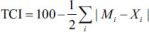
where
Mi represents the import share of the partner country in sector i;
Xi represents the export share of the reporting country in sector i.
A higher TCI value indicates a greater degree of trade complementarity between the two economies. In this study, the TCI is calculated in both directions (Vietnam’s exports to India and India’s exports to Vietnam) in order to assess the level of compatibility in the bilateral trade structure over time.
Revealed Comparative Advantage
The RCA index is employed to identify the comparative advantages of each country across sectors in the partner’s market. The study adopts a market-oriented approach, whereby the export structure of a country in the partner market is compared with that country’s overall global export structure. The index is calculated as follows:
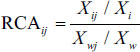
where
Xij: represents the exports of country i in sector j;
Xi : denotes the total exports of country i;
Xwj: refers to world exports in sector j;
Xw: represents total world exports.
If RCA > 1, the country is considered to possess a comparative advantage in that sector. The RCA results make it possible to identify patterns of vertical division of labour between Vietnam and India within GVCs.
The study combines both quantitative and qualitative approaches. The Theil, RCA and TCI indices are employed to analyse the structure of merchandise trade, while qualitative analysis is used to interpret the findings within the broader context of GVCs and trade in services. In addition, the analysis of services trade is conducted based on sectoral composition and trade balances in order to clarify differences in economic capabilities between the two economies. This approach enables a comprehensive assessment not only of trade scale and trends, but also of the structure and degree of complementarity in bilateral economic relations. Accordingly, it provides an empirical foundation for evaluating the feasibility of establishing a CEPA between Vietnam and India.
Empirical Results
Trade Dynamics (2010–2024)
During the period 2010–2024, merchandise trade between Vietnam and India experienced substantial growth in both scale and depth of economic linkage. Based on the author’s calculations using the data presented in Figure 1, total bilateral trade turnover increased from $2.75 billion in 2010 to $14.86 billion in 2024, representing an increase of more than fivefold over a 14-year period. In particular, the post-2016 period witnessed a significant acceleration, with bilateral trade expanding by nearly 2.75 times within only 5 years. This trend was closely associated with two major institutional developments, namely the implementation of the AITIG in 2010 and the elevation of bilateral relations to a Comprehensive Strategic Partnership in 2016.
Figure 1. Merchandise Trade Turnover Between Vietnam and India, 2010–2024. Unit: USD million.

Source: Author’s compilation based on data obtained from the International Trade Centre (ITC) Trade Map database (2026).
However, the growth of merchandise trade between the two countries has not been fully balanced between exports and imports. During the initial period (2010–2016), Vietnam consistently recorded a trade deficit, with the deficit reaching $770 million in 2010 before gradually narrowing to near balance by 2016. From 2018 onward, the trade balance shifted markedly as Vietnam moved into a trade surplus position, with the surplus reaching approximately $2.39 billion in 2018 and increasing to more than $3.24 billion by 2024 (Figure 1). This development reflects a structural transformation in bilateral trade relations, as Vietnam has gradually strengthened its export capacity in manufacturing and processing industries.
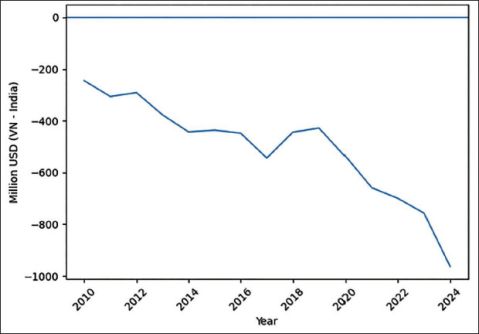
The bilateral services trade balance remained consistently in India’s favour throughout the study period. According to Figure 2, Vietnam experienced a prolonged services trade deficit with India, and the level of deficit increased significantly after 2017. By 2024, the gap had reached its highest level within the observed data series. The evolution of the trade balance directly reflects the export structures of the two economies: while India rapidly expanded high-value-added service sectors, Vietnam continued to rely heavily on traditional services, which were more vulnerable to external shocks such as the COVID-19 pandemic.
Trade Structure Analysis
An analysis of the trade structure indicates that Vietnam–India economic relations exhibit a pronounced pattern of sectoral complementarity. On the Vietnamese side, the export structure to India during the 2018–2024 period experienced a substantial shift from traditional agricultural commodities towards manufactured industrial products and high-technology goods. In particular, HS85 (electrical machinery, electronics and components) emerged as the dominant export category, generating a cumulative trade surplus of nearly $22 billion. This reflects Vietnam’s increasingly central role as a manufacturing and export hub within regional GVCs. In addition, intermediate industrial products such as HS74 (copper), HS28 (inorganic chemicals) and HS73 (iron and steel products) also recorded significant growth, indicating Vietnam’s deeper integration into industrial supply chains. At the same time, traditional export products including coffee, spices (HS09) and fruits (HS08) continued to maintain stable trade surpluses, reflecting the coexistence of traditional comparative advantages and ongoing industrialisation. Furthermore, light manufacturing industries such as wood products (HS44) and footwear (HS64) experienced strong growth in recent years, suggesting the expansion of India’s consumer market for processed Vietnamese goods. Overall, this trade structure reflects a dual-pillar export model in Vietnam, driven by the simultaneous expansion of high-technology industries and processed consumer goods sectors.
Figure 2. Vietnam–India Services Trade Balance (2010–2024).
Source: Author’s compilation based on data obtained from the World Trade Organization (WTO) Statistics Database (2026).
Conversely, India’s export structure to Vietnam is primarily concentrated in intermediate inputs and essential goods serving production activities. Major surplus categories include iron and steel (HS72), cotton (HS52), pharmaceuticals (HS30) and organic chemicals (HS29), together with several agricultural products such as meat (HS02), cereals (HS10) and fishery products (HS03). Notably, pharmaceuticals and cotton exhibit a pattern of structural trade surplus, reflecting Vietnam’s dependence on Indian supply in these sectors. India maintains a strong competitive advantage in generic medicines and large-scale pharmaceutical manufacturing, while Vietnam remains constrained in its domestic capacity for active pharmaceutical ingredients (APIs) as well as various finished pharmaceutical products. Consequently, pharmaceutical imports from India remain both essential and stable over time. Similarly, textile raw materials, particularly cotton (HS52), highlight India’s role as a key supplier for Vietnam’s export-oriented textile and garment industry. Cotton imports are not intended for final consumption; rather, they serve as intermediate inputs within regional and GVCs, contributing to Vietnam’s export production for third-country markets.
In the services sector, the trade structure between the two countries exhibits a pronounced asymmetry. Vietnam’s service exports to India remain largely concentrated in traditional service industries, particularly travel and transport services. Throughout most of the observed period, travel services accounted for the largest share, exceeding 60% of Vietnam’s total service exports to India in several years. Transport services generally ranked second, while knowledge-intensive sectors such as telecommunications, information technology and computer services (ICT) represented only a relatively small proportion. Although the ICT category showed signs of expansion after 2020, its scale and share remained considerably lower than those observed in the opposite direction. This structure suggests that Vietnam’s service exports continue to rely heavily on tourism flows and logistics activities rather than on knowledge-based and high-technology services.
By contrast, India’s service export structure to Vietnam is more diversified and has increasingly shifted towards knowledge-intensive activities. During the 2010–2016 period, travel services continued to play an important role; however, a clear structural transformation emerged after 2020. ICT expanded rapidly and became one of the leading export categories. At the same time, other business services also recorded a steady upward trend. This transformation reflects India’s comparative advantage in information technology, software outsourcing and globally integrated professional services. Particularly in the post-COVID-19 period, although travel services experienced a temporary decline in 2020, India’s ICT services recovered rapidly and continued to grow strongly in subsequent years.
Overall, Vietnam’s service export structure remained relatively stable throughout the 2010–2024 period, with only limited structural transformation. In contrast, India demonstrated a clear tendency to reallocate resources towards higher-productivity and technology-intensive service industries. The increasing share of ICT and business services in India’s export structure indicates a broader process of digital transformation and deeper integration into global service value chains. Taken together, the findings suggest that the asymmetry in Vietnam–India services trade is not merely cyclical in nature but is rooted in structural factors. Differences in technological capabilities, human capital quality and the level of digital infrastructure development play a critical role in shaping the service export structures of the two economies.
Global Value Chain-based Analysis
The analysis based on the GVC framework indicates that the Vietnam–India trade structure exhibits a relatively clear pattern of vertical complementarity.
A comparison of the Theil Index across the two trade flows reveals significant structural differences between Vietnam and India during the period 2010–2024. While Vietnam’s Theil Index remained relatively high and showed an upward trend after 2018 (ranging from approximately 2.0 to 2.4), reflecting a high degree of export concentration in several key sectors, India’s Theil Index was considerably lower and gradually declined over time (approximately 1.2–1.6), indicating a more diversified export structure. In particular, the post-2018 period witnessed a clear divergence between the two economies: Vietnam increased its export concentration, associated with the expansion of electronics and FDI-driven manufacturing industries, whereas India continued to diversify its export structure towards Vietnam, thereby reinforcing its role as a supplier of intermediate inputs. This trend reflects a vertically fragmented division of labour within GVCs, in which the two economies are not in direct competition but instead complement each other at different stages of the production chain.
The RCA analysis further demonstrates substantial differences in the comparative advantage structures of Vietnam and India, thereby reinforcing the existence of vertical complementarity in bilateral trade relations. In 2024, Vietnam recorded 29 HS2 product groups with an RCA greater than 1, among which five groups exhibited particularly high RCA values, including HS50 (silk), HS14, HS74 (copper and articles thereof), HS28 (inorganic chemicals) and HS12. These findings suggest that Vietnam’s export advantages in the Indian market are not limited to traditional manufacturing sectors but increasingly extend to intermediate materials and industrial chemicals used in production processes. Notably, HS74 and HS28 maintained consistently high RCA levels, reflecting Vietnam’s growing role as a supplier of industrial inputs to the Indian market. By contrast, HS85—the largest export category from Vietnam to India in terms of trade value—recorded an RCA of only approximately 1.239 in 2024. This indicates that although electronics account for a substantial share of bilateral trade, the degree of specialisation of Vietnam’s electronics sector in the Indian market is not significantly higher than its overall global export structure.
Conversely, India recorded 38 HS2 product groups with an RCA greater than 1 in 2024, of which eight groups demonstrated particularly high RCA values, notably HS02 (meat and edible meat offal), HS14, HS68, HS71, HS78, HS03, HS69 and HS09. In addition, product groups such as pharmaceuticals (HS30), cotton (HS52), inorganic chemicals (HS28) and base metals consistently maintained high RCA levels over many years, reflecting India’s role as a supplier of raw materials, intermediate inputs and essential goods for production activities in Vietnam. A comparison of the RCA structures of the two economies indicates that Vietnam tends to specialise in downstream manufacturing and assembly industries, whereas India maintains comparative advantages in upstream sectors such as raw materials, chemicals, pharmaceuticals and agricultural products. This suggests that bilateral trade relations are characterised more by vertical complementarity than by direct competition. From a GVC perspective, the RCA results reinforce the argument that Vietnam and India occupy different yet potentially interconnected positions within a shared regional production structure. This creates a favourable foundation for promoting a comprehensive framework such as a CEPA aimed at strengthening supply chain integration and expanding bilateral production linkages.
The TCI results indicate that the compatibility between India’s export structure and Vietnam’s import structure was considerably higher than in the reverse direction throughout the 2010–2024 period. India’s TCI fluctuated within the range of 40–54, significantly exceeding Vietnam’s TCI level of 24–38 for exports to India. A comparison of the two-way TCI results suggests that Vietnam–India trade relations exhibit a certain degree of asymmetry. While India’s export structure aligns relatively well with Vietnam’s import demand, Vietnam’s export structure only moderately satisfies India’s import needs. This indicates that Vietnam currently participates in bilateral trade primarily as a downstream manufacturing and assembly hub, whereas India functions as a supplier of intermediate inputs and essential goods for production chains.
Discussion: Implications for Comprehensive Economic Partnership Agreement
The empirical findings indicate that Vietnam–India trade relations are increasingly developing a relatively clear pattern of vertical complementarity within GVCs. While Vietnam tends to specialise in downstream manufacturing and assembly industries such as electronics, metals and light manufacturing, India maintains comparative advantages in upstream sectors including industrial inputs, chemicals, pharmaceuticals and knowledge-intensive services. This divergence reflects a complementary division of labour rather than direct competition between the two economies.
From a GVC perspective, the RCA, TCI and Theil Index results suggest that bilateral trade between Vietnam and India extends beyond the simple exchange of final goods and is increasingly characterised by cross-border production linkages. Nevertheless, the current level of trade complementarity remains moderate and has not yet been fully institutionalised. Existing mechanisms such as the ASEAN–AITIG have primarily facilitated merchandise trade liberalisation, but have not effectively addressed non-tariff barriers, restrictions in services trade, or issues related to investment, logistics and technical standards. These constraints continue to increase transaction costs and limit the potential for deeper integration between the two economies within regional value chains.
The study also reveals a notable asymmetry in the bilateral trade structure. While India’s export structure demonstrates a relatively high degree of compatibility with Vietnam’s import demand, Vietnam’s export structure only moderately matches the needs of the Indian market. This reflects the reality that Vietnam still participates primarily in downstream assembly and manufacturing activities with relatively limited value-added content, whereas India occupies a stronger position in intermediate input industries and knowledge-intensive services. Without a more comprehensive cooperative framework, this structure could create risks of asymmetric dependence in the long term.
In this context, a CEPA may be considered a more appropriate institutional framework than a traditional Free Trade Agreement (FTA). Unlike conventional FTAs, which primarily focus on tariff reduction for goods, CEPA frameworks allow cooperation to expand into broader areas such as services, investment, technical standards, trade facilitation and institutional cooperation. This is particularly important in the context of modern trade, where economic exchanges are increasingly intertwined with investment, logistics, technology and the movement of natural persons. A Vietnam–India CEPA could contribute to reducing transaction costs, strengthening production linkages and enabling firms from both countries to participate more deeply in regional value chains. Moreover, CEPA carries strategic significance in the context of global economic restructuring and the growing ‘China+1’ trend. Vietnam possesses advantages in manufacturing capacity, extensive FTA networks and access to international markets, while India holds strengths in industrial inputs, technology-based services and market scale. The combination of these complementary advantages could provide the foundation for the emergence of a new production linkage axis in Asia, thereby enhancing the resilience of both countries against geopolitical shocks and the fragmentation of global supply chains.
Nevertheless, the promotion of a CEPA framework also presents several important challenges. For India, the primary concern remains the potential expansion of its merchandise trade deficit, particularly as Vietnam continues to maintain a trade surplus. Meanwhile, Vietnam may face increasing competitive pressures in certain sectors such as raw materials, chemicals and services. In addition, differences in technical standards, SPS/TBT regulations and enterprise capacity between the two countries may increase compliance costs for businesses. These challenges suggest that an effective CEPA should be designed in a gradual and flexible manner, with greater emphasis on institutional cooperation rather than focusing solely on market liberalisation.
Policy Implications
The findings indicate that Vietnam–India trade relations exhibit a relatively strong pattern of vertical complementarity, thereby providing a favourable foundation for promoting a CEPA framework in the future. However, for CEPA to function as an instrument for strengthening GVC linkages rather than merely expanding merchandise trade, both Vietnam and India will need to undertake appropriate policy adjustments.
For Vietnam, the foremost priority is to upgrade its position within regional value chains. The RCA and Theil Index results suggest that Vietnam is becoming increasingly specialised in downstream assembly and processing industries, particularly in the electronics sector. While this specialisation has contributed significantly to export growth, it has also increased dependence on foreign-invested enterprises and imported intermediate inputs. Accordingly, Vietnam should utilise CEPA as a platform to attract Indian investment into upstream and intermediate-input industries such as chemicals, pharmaceuticals, industrial materials and supporting industries, thereby enhancing localisation rates and domestic value-added in production. At the same time, Vietnam needs to strengthen its standards infrastructure, quality inspection capacity and logistics systems in order to reduce transaction costs and better comply with the technical requirements of the Indian market. In the services sector, Vietnam should promote cooperation in high-quality human resource development, particularly in information technology, logistics and digital services, with the aim of gradually narrowing the capability gap with India. In addition, Vietnam should adopt a flexible and phased approach towards CEPA implementation. Market liberalisation should proceed incrementally in order to minimise competitive pressures on domestic firms that remain constrained in terms of technological capacity and scale. Simultaneously, Vietnam needs to strengthen trade remedy mechanisms, rules of origin and quality-control systems to reduce the risks of trade circumvention and excessive dependence on external supply sources.
For India, the TCI results indicate that the country’s export structure demonstrates a relatively high degree of compatibility with Vietnam’s import demand, particularly in the areas of intermediate inputs, chemicals, pharmaceuticals and knowledge-based services. This suggests that India possesses significant opportunities to expand its role within regional supply chains through deeper cooperation with Vietnam. However, to effectively capitalise on these opportunities, India needs to moderate its overly cautious approach towards trade agreements and shift from a ‘trade balance-oriented’ perspective towards a ‘value chain integration-oriented’ approach. In the context of contemporary trade, which is increasingly intertwined with investment and cross-border production, an excessive focus on merchandise trade deficits may constrain India’s ability to integrate more deeply into regional production networks. India also needs to strengthen investment and services cooperation with Vietnam. Indian firms in information technology, pharmaceuticals, logistics and technical services could utilise Vietnam as a manufacturing hub and a gateway to the broader ASEAN market. At the same time, expanding the movement of professionals, experts and skilled labour within the CEPA framework would help strengthen production linkages and facilitate knowledge transfer between the two economies. In addition, India should promote mutual recognition mechanisms in technical standards, sanitary and phytosanitary (SPS) measures, and quality certification in order to reduce compliance costs and facilitate bilateral trade.
At the bilateral level, both countries should regard CEPA not merely as a trade agreement, but as a strategic cooperation framework for the co-creation of a Vietnam–India value chain in the context of ongoing global economic restructuring. The establishment of a comprehensive cooperation mechanism encompassing trade, investment, services, logistics and technical standards could enable both countries to better capitalise on the ‘China+1’ trend, reduce dependence on highly concentrated supply chains, and enhance resilience against geopolitical and global economic disruptions.
Conclusion
This study systematically examines the trade structure between Vietnam and India during the period 2010–2024 from the perspective of GVCs in order to assess the feasibility of promoting a CEPA between the two countries. The findings indicate that bilateral trade has expanded significantly in both scale and interconnectedness; however, the trade structure between the two economies remains markedly asymmetric.
The Theil Index results show that Vietnam’s exports to India are considerably more concentrated than India’s exports to Vietnam, reflecting Vietnam’s strong specialisation in several manufacturing and electronics industries. In contrast, India’s exports to Vietnam exhibit a more diversified structure, primarily consisting of raw materials, chemicals, pharmaceuticals and intermediate goods used in production processes. The RCA analysis further confirms the differences in comparative advantage patterns between the two countries. Vietnam tends to assume a downstream role in manufacturing and assembly activities, whereas India plays a more upstream role by supplying industrial inputs and knowledge-intensive services. At the same time, the TCI suggests that the degree of trade complementarity between the two economies has gradually improved, particularly after 2020, although the level of integration remains moderate rather than deep.
From a GVC perspective, these findings suggest that Vietnam–India trade relations are characterised more by vertical complementarity than by direct competition. This implies that the main potential for bilateral cooperation does not primarily lie in the simple expansion of merchandise trade, but rather in the formation of cross-border production linkages and regional supply chains. In this context, a CEPA framework may be more appropriate than a traditional FTA, as it allows cooperation to expand into broader areas such as investment, services, logistics, technical standards and the movement of natural persons.
Nevertheless, the study also identifies several important limitations. The current level of trade complementarity remains moderate, while non-tariff barriers, differences in technical standards and disparities in enterprise capacity continue to constrain deeper economic integration between the two countries. Furthermore, the analysis mainly relies on HS2-level trade data, which does not fully capture value-added participation and firm-level linkages within GVCs. Future research could therefore focus on more detailed industry- and firm-level analyses in order to better evaluate the potential impact of CEPA on industrial upgrading and regional supply chain restructuring.
In the context of a rapidly restructuring global economy driven by the ‘China+1’ strategy, strategic competition and supply chain fragmentation, the key issue is no longer simply whether Vietnam and India should liberalise trade, but whether the two economies can effectively integrate into a shared regional production structure through a comprehensive framework such as CEPA.
Acknowledgement
This article is the result of the author’s independent research.
Declaration of Conflicting Interests
The author declared no potential conflicts of interest with respect to the research, authorship and/or publication of this article.
Funding
The author received no financial support for the research, authorship and/or publication of this article.
Research Ethics Statement
The author confirms that this manuscript has not been published previously nor submitted to any other journal for consideration. All data and references used in this study are properly cited in accordance with academic standards.
Balassa, B. (1965). Trade liberalisation and “revealed” comparative advantage. The Manchester School, 33(2), 99–123.
Baldwin, R. (2016). The great convergence: Information technology and the new globalization. Harvard University Press.
Dhar, B. (2020). India’s trade policy shift and its implications. Economic & Political Weekly, 55(32), 12–15.
Gereffi, G. (2018). Global value chains and development: Redefining the contours of 21st century capitalism. Cambridge University Press.
International Trade Centre. (2026). Trade map database. https://www.trademap.org
Iqbal, Z., Yadav, R., & Phan, T. H. (2024). Trade dynamics between India and Vietnam: Emerging trends and competitiveness. Journal of Asian Economics, 85, 101512.
Michaely, M. (1996). Trade preferential agreements in Latin America: An ex-ante assessment (Policy Research Working Paper No. 1583). The World Bank.
Nguyen, X. T., Nguyen, D. H., & Nguyen, T. H. (2018). The impact of ASEAN–India Free Trade Agreement on Vietnam’s trade flows: A stochastic frontier gravity approach. Asian Economic Journal, 32(4), 375–398.
Panagariya, A. (2007). Free trade agreements and India: Gains and challenges. The World Economy, 30(3), 341–365.
Parteka, A., & Tamberi, M. (2013). What Determines Export Diversification in the Development Process? Empirical Assessment. The World Economy, 36(6), 807–826. https://doi.org/10.1111/twec.12064
World Trade Organization. (2026). WTO statistics database. https://www.wto.org
Yeats, A. (1998). Does Mercosur’s trade performance raise concerns about the effects of regional trade arrangements? World Bank Economic Review.
