
IIFT International Business and Management Review Journal

1Foreign Trade Researcher, Independent, Mumbai, Maharashtra, India
2Current affiliation: Gem & Jewellery Export Promotion Council (GJEPC), Mumbai, Maharashtra, India

Creative Commons Non Commercial CC BY-NC: This article is distributed under the terms of the Creative Commons Attribution-NonCommercial 4.0 License (http://www.creativecommons.org/licenses/by-nc/4.0/) which permits non-Commercial use, reproduction and distribution of the work without further permission provided the original work is attributed.
This study examines the impact of government Export Promotion Programmes (EPPs) on the export performance (EP) of Indian apparel firms. Using primary data from Maharashtra-based exporters, the research employs partial least squares-structural equation modelling to test relationships between managerial perception, awareness, export knowledge, perceived benefits and EP. Findings indicate that managerial perception, firm-level awareness and export knowledge significantly enhance EP, whereas perceived benefits of EPPs show no significant effect. These results emphasise the necessity of improving awareness, simplifying administrative procedures and increasing scheme effectiveness. The study provides valuable firm-level evidence from a developing economy on EPPs’ role in driving export growth.
Export Promotion Programmes, export knowledge, export performance, firm-level awareness, managerial perception, PLS-SEM
Introduction
In India, significant 1990s reforms introduced export incentives and removed discretionary controls (Kathuria, 1996). These measures focused on increasing promotional activities, reducing quantitative restrictions and developing infrastructure. During this period, tariffs were eased and several export promotion schemes were introduced, including Duty Exemption, Advance Licence, DEPB, Duty Drawback (DBK), Focus Market Scheme (FMS), Focus Product Scheme (FPS), MLFPS, MDA and MAI. Digital trade facilitation via SWIFT and EDI further modernised the export environment.
Macro-level research generally links export orientation with growth (Balassa, 1978; Coughlin & Cartwright, 1981). However, firm-level evidence remains mixed (Wang et al., 2017). Gencturk and Kotabe (2001) found that Export Promotion Programmes (EPPs) influence performance directly and indirectly, while Lages and Montgomery (2005) reported an insignificant total effect. Francis and Collins (2004) noted that active exporters benefit more from EPPs than experienced firms.
Indian scholars confirmed that export profitability and growth increased following trade liberalisation (Kathuria, 1996; Veeramani, 2007, 2012). Despite extensive macroeconomic research (Bajpai & Biberman, 2020; Banik, 2001; Bhat, 2011; Ghemawat & Patibandla, 1998; Joshi & Little, 1994; Kanagasabapathy & Tilak, 2013; Kumar, 2010; Mukherjee, 2012; Mukherjee & Mukherjee, 2012; Nagraj, 2019; Panagariya, 2004; Singh & Singla, 2012; Suvrathan, 1991; Veeramani, 2007, 2012; Virmani, 2001), few studies (Dholakia & Kapur, 2001; Naidu & Rao, 1993; Vanderleest, 1996) empirically assess EPPs at the firm level.
Given that EPPs are utilised by both large and small firms, examining their effectiveness at the firm level remains an important area of research, particularly in light of the sustained and extensive export promotion efforts undertaken by the Government of India over the past few decades. Such an analysis enables scholars to validate the impact of EPPs on firm-level exports using Indian firms as a case. Moreover, the impact of EPPs on firms’ export performance (EP) is influenced by firm-specific characteristics, particularly levels of awareness, export knowledge, perceptions of EPP benefits and managerial perceptions of government export promotion schemes (Ahmed et al., 2002; Freixanet, 2012; Gencturk & Kotabe, 2001; Seringhaus, 1987).
Reid (1981) classified the determinants of EP into three broad categories: (a) managerial determinants, including managerial skills, training, export experience and managerial perceptions of government export promotion schemes; (b) organisational determinants, such as firm age, firm size, export knowledge and awareness; and (c) environmental determinants, including export market attractiveness, market barriers and market competitiveness. EPPs provide external support to help firms acquire the information, knowledge, experience and resources required to formulate effective export strategies and improve EP (Singer & Czinkota, 1994). Accordingly, key drivers of EP are considered in this study to assess the impact of EPPs on firms’ EP.
The objectives of the study are: (a) to assess the impact of EPPs on firms’ EP through key EP determinants; and (b) to examine the differential impact of specific export promotion schemes on firms’ EP.
To achieve these objectives, the study employs an empirical approach using firm-level data to examine the relationship between EPPs, key performance determinants and EP. By providing evidence on the effectiveness of export promotion initiatives, the study contributes to the literature on export promotion policy and offers insights for policymakers in designing more targeted mechanisms to enhance the effectiveness of export support for exporters. Moreover, existing studies examine export promotion measures in developing economies; firm-level evidence on the effectiveness of EPPs in labour-intensive manufacturing sectors remains limited. This study addresses this gap by providing firm-level empirical evidence from the apparel sector in a major developing economy, thereby contributing to the literature on trade policy effectiveness and EP.
Literature Review and Formulating Hypotheses
Theoretically, this study is anchored in the resource-based view (RBV) (Barney, 1991) and the internationalisation process model (Johanson & Vahlne, 1977, 1990). The RBV posits that firm-level EP depends on the deployment of tangible and intangible resources like managerial resource-enhancing mechanisms for firms in emerging economies. Complementing this, internationalisation theory explains export growth as a learning-driven, incremental process (Johanson & Vahlne, 1977, 1990). Government EPPs reduce uncertainty and accelerate experiential learning.
Seringhaus (1987) suggested that export aid programmes benefit firms possessing the capability to utilise support. Arthur (1988) observed that US initiatives like seminars and credit insurance effectively reduced risks. Vanderleest (1996) found government publications effective but underutilised. Wilkinson and Brouthers (2006) reported that trade fairs have a positive association with exports, whereas trade missions show no correlation.
Kotabe and Czinkota (1992) presented a framework categorising firms into five stages: partial interest, exploring, experimental, experienced with limited scope and experienced exporters. They concluded that managerial ability is generally more important than financing (Kotabe & Czinkota, 1992). Gencturk and Kotabe (2001) identified EPP use as a critical determinant affecting performance directly and indirectly through export involvement. Conversely, Lages and Montgomery (2005) found the total effect to be non-significant, as positive direct effects are offset by negative indirect effects via pricing adaptation. Francis and Collins (2004) suggested that sporadic and active exporters benefit most, with limited short-term impact on experienced firms (Francis & Collins, 2004).
Martincus and Carballo (2010) found that smaller, inexperienced firms derive greater benefits than larger firms. Yunis and Shamsuddoha (2009) showed that EPP impact is largely indirect, operating through internal determinants like export knowledge and commitment. Girma et al. (2009) documented that production subsidies stimulate existing exporters but are less effective for market entry. Freixanet (2012) observed a positive relationship between firm size, involvement and awareness. Leonidou and Katsikeas (1996) demonstrated that national EPPs strengthen essential resources for marketing strategies.
Haddoud et al. (2018) found that informational EPPs (seminars) improve local buyer relationships, while experiential EPPs (exhibitions) strengthen foreign buyer links. Wang et al. (2017) highlighted that marketing capabilities enhance information-related EPP effectiveness, while financial aid moderates the process. Sharma et al. (2018) reported that EPPs exert a positive indirect impact by improving perceptions of market attractiveness.
Munch (2015) found EPPs enhance value addition and productivity among small firms. Han and Park (2019) concluded that information-, operational- and experience-focused EPPs predict small and medium-sized enterprise (SME) value chain performance. Malca et al. (2019) found that prior performance positively influences current resources and operations. Mota et al. (2021) reported that participation positively influences performance, especially for firms with prior experience, noting that firm size has a positive effect while age exerts a negative influence (Mota et al., 2021).
In the Indian context, Naidu and Rao (1993) developed a seven-step framework to enhance competitiveness, including need-based programmes and addressing bureaucratic red tape. Obadia and Vida (2024) demonstrated that EPPs and exporter–importer cooperation significantly shape outcomes. Singh et al. (2024) showed that institutional support indirectly enhances performance through readiness. Mansor and Cheah (2024) highlighted governance perspectives in EPP effectiveness, while Chopra et al. (2024) reaffirmed the relevance of promotion strategies for SMEs.
Based on the review of the literature, it is evident that firms’ EP is closely associated with a range of internal and external determinants. Accordingly, hypotheses are formulated in this study to examine the impact of various export promotion schemes implemented by the Government of India on the EP of Indian firms. Furthermore, from a trade policy perspective, EPPs are expected to enhance firm capabilities by reducing information, compliance and market-entry costs, which in turn improves EP. This provides the theoretical basis for the hypotheses tested in this study.
Managerial Perception About Government Schemes and EP
EPPs are vital components of the export environment provided by governments and institutions to support firms, particularly SMEs (Wheeler, 1990). Positive managerial perceptions of this environment are key determinants of EP (Abay & Slater, 1989; Zou & Stan, 1998). Pointon (1978) used managerial perception to assess the usefulness of EPPs, while Shamsuddoha (2004, 2009) emphasised that managers’ attitudes significantly influence performance. Sood and Adams (1984) showed that the export environment shapes managerial decision-making. Managers viewing the environment favourably are more likely to acquire knowledge and develop effective strategies. Cavusgil and Zou (1994) and Donthu and Kim (1993) suggested that positive perceptions regarding government support and markets instil confidence, helping managers reduce uncertainty and overcome barriers to increase international penetration.
Consequently, in this study managerial perception is treated as a key antecedent influencing firms’ engagement with EPPs and their subsequent EP in this study.
H1: There exists a positive impact of managers’ perceptions of EPPs on firms’ EP.
Firms’ Level of Awareness and EP.
Awareness regarding external assistance has grown alongside the importance of knowledge about government export promotion schemes (Seringhaus, 1987). Studies by Czinkota and Ricks (1981), Kedia and Chhokar (1986) and Seringhaus (1986) found that ITA programmes were underutilised due to low awareness, limiting export sales. Conversely, Vanderleest (1996) argued that these programmes were known and not underutilised. Mansfield et al. (1987), Wheeler (1990) and Pahuud de Mortange and Van Gentt (1991) reported that exporters of various sizes derived tangible benefits from promotional support. However, SMEs often possess limited knowledge of services (Reid, 1981; Seringhaus, 1986, 1987). Weil (1978) and Kedia and Chhokar (1986) concluded that low awareness remains a major challenge, preventing firms from expanding export operations effectively.
Accordingly, this study treats firms’ level of awareness of government export promotion schemes as a key explanatory variable influencing EP outcomes.
H2: There exists a positive impact of firms’ awareness levels of EPPs on firms’ EP.
Firms’ Export Knowledge and EP
Internationalisation theories proposed by Johanson and Vahlne (1977, 1990) highlight the importance of information and knowledge in enabling firms to integrate into foreign markets and increase export commitment. These theories argue that a lack of knowledge and resources constitutes a major barrier, which can be mitigated through experiential learning. Similarly, resource-based theory posits that tangible and intangible resources, including knowledge and expertise, are critical for achieving competitiveness and operational efficiency (Barney, 1991; Coff, 1997). As firms accumulate export-related knowledge concerning procedures, policies and promotional schemes, managers gain a better understanding of foreign markets, establish stronger relationships with overseas clients, design effective marketing programmes and ultimately enhance EP (Abay & Slater, 1989).
Accordingly, this study incorporates firms’ export knowledge as a key determinant in explaining variations in EP among Indian exporting firms.
H3: There exists a positive impact of firms’ export knowledge of EPPs on firms’ EP.
Managers’ Perception About Benefits of EPPs and EP
Several studies have evaluated EPPs by examining managerial perceptions of their usefulness. Seringhaus (1986) and others utilised qualitative approaches to assess these perceptions. Generally, promotional measures exhibit a positive relationship with performance, with Durmu.png) o
o.png) lu et al. (2012), Geldres-Weiss and Carrasco-Roa (2011), Martincus and Carballo (2010), Shamsuddoha and Ali (2004, 2009) and Lages and Montgomery (2005) reporting significant associations between EPPs and firm-level outcomes. Experiential EPPs like exhibitions and trade missions show strong positive correlations with performance (Durmuolu et al., 2012; Freixanet, 2012), though some studies found these relationships statistically insignificant (Faroque & Takahashi, 2012; Wilkinson & Brouthers, 2006). Geldres-Weiss and Carrasco-Roa (2011) noted that EPP effectiveness varies, while Wilkinson and Brouthers (2006) found marketing support particularly impactful. Clarke (1991) argued that awareness must be paired with the capability to utilise programmes effectively. Similarly, Yannopoulos (2010) emphasised aligning assistance with specific exporter needs. Conversely, Seringhaus (1987) found no significant relationship between trade mission participation and outcomes like export intensity or volume. Accordingly, this study treats managerial perception about the benefits of government export promotion schemes as a critical determinant influencing firms’ EP.
lu et al. (2012), Geldres-Weiss and Carrasco-Roa (2011), Martincus and Carballo (2010), Shamsuddoha and Ali (2004, 2009) and Lages and Montgomery (2005) reporting significant associations between EPPs and firm-level outcomes. Experiential EPPs like exhibitions and trade missions show strong positive correlations with performance (Durmuolu et al., 2012; Freixanet, 2012), though some studies found these relationships statistically insignificant (Faroque & Takahashi, 2012; Wilkinson & Brouthers, 2006). Geldres-Weiss and Carrasco-Roa (2011) noted that EPP effectiveness varies, while Wilkinson and Brouthers (2006) found marketing support particularly impactful. Clarke (1991) argued that awareness must be paired with the capability to utilise programmes effectively. Similarly, Yannopoulos (2010) emphasised aligning assistance with specific exporter needs. Conversely, Seringhaus (1987) found no significant relationship between trade mission participation and outcomes like export intensity or volume. Accordingly, this study treats managerial perception about the benefits of government export promotion schemes as a critical determinant influencing firms’ EP.
H4: There exists a positive impact of the managers’ perception about the benefits of EPPs on firms’ EP.
Categories of EPPs and EP
Shamsuddoha (2009) found that EP is influenced by managerial perceptions, knowledge and commitment stemming from market development activities. Market-oriented EPPs, such as trade fairs and seminars, provide critical information for effective marketing strategies and increased sales. Financial EPPs indirectly boost performance by generating resources for overseas operations and shaping trade strategies that affect costs. While EPPs generally enhance performance, excessive or poorly targeted assistance can have negative indirect effects. Consequently, this study examines the differential impact of market development, financial and technology development EPPs on the Indian apparel sector. It considers key firm-level determinants that influence how effectively this support is utilised.
Accordingly, this study examines the differential impact of market development, financial and technology development EPPs on firms’ EP in the Indian apparel sector, taking into account key firm-level determinants that influence the effective utilisation of export promotion support.
H5: There exists a difference in the impact of different EPPs on EP.
Research Methodology
A structured questionnaire was used for a self-administered field survey to collect primary data from senior export managers and owners of apparel firms in Mumbai. Conducted between June and December 2023, the survey yielded 151 valid responses from micro, small and medium enterprise (MSME) units, satisfying the requirement of at least 10% of the identified sampling frame.
Variables and Measurement
The study incorporates multiple independent and dependent variables as detailed in Table 1.
Results
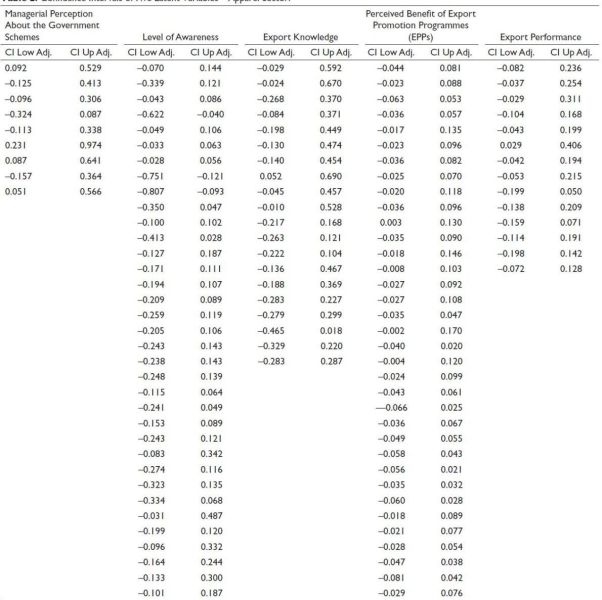
Hypotheses were tested using variance-based partial least squares-structural equation modelling (PLS-SEM) (version 3). PLS-SEM is ideal for reflective/formative constructs and smaller sample sizes (Hair et al., 2019). Confirmatory tetrad analysis (CTA-PLS) confirmed that all constructs are reflective (Table 2).
Table 1: Conceptual and Operational Definition of Variables.

Measurement Fit for Reflective Models
The measurement model’s adequacy was evaluated through indicator reliability, internal consistency (Cronbach’s alpha/composite reliability), convergent validity (average variance extracted [AVE]) and discriminant validity (Fornell–Larcker/heterotrait–monotrait ratio [HTMT]).
Table 2. Confidence Intervals of Five Latent Variables—Apparel Sector.
Indicator reliability: Of 45 initial items, 5 were removed for low factor loadings. Remaining items meet the .png) 0.70 threshold and are statistically significant (p < .05) (Table 3).
0.70 threshold and are statistically significant (p < .05) (Table 3).
The final model consists of five latent variables:
Table 3. Measurement Fit for Reflective Models: Indicator Reliability (Loadings) and Construct Reliability and Validity—Apparel Sector.

All reliability and validity conditions were met, rendering the model fit for further assessment (Table 4).
Assessing the Structural Model
The results presented in Table 5 indicate that all hypothesised relationships between the antecedent variables and firms’ EP are supported at the 5% level of significance, with the exception of one hypothesis. These findings suggest that, among the factors examined in this study, firms’ levels of awareness, firms’ export knowledge and managers’ perceptions of government export promotion schemes exert a statistically significant and positive influence on EP.
Table 4. Assessment of Measurement Fit for Reflective Model.

Table 5. Hypothesis Testing—Results.

Table 6. Collinearity Statistics Inner (Variance Inflation Factor [VIF]) Values.
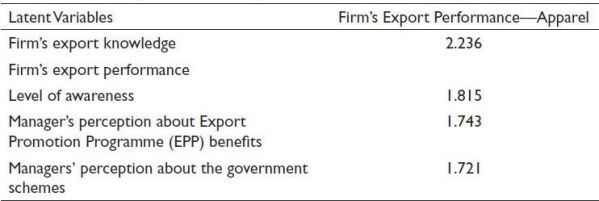
After establishing measurement model reliability and validity, the structural model was assessed to test the proposed hypotheses and evaluate EPP effects on EP. Regression paths were estimated, and inner variance inflation factor (VIF) values remained below 3, indicating an absence of multicollinearity (Table 6).
Constructs were categorised into five dimensions: managerial perceptions of schemes, awareness levels, export knowledge, perceived benefits and EP. A bootstrapping procedure with 5,000 subsamples was conducted via Smart-PLS for the 151 observations. The model explains 63.7% of the variance in EP, indicating adequate explanatory power (Figure 1). Adjusted R2 showed a marginal decrease, suggesting that additional predictors did not further improve fit (Table 7). Results in Table 5 show that all hypothesised relationships, except one, are supported at the 5% significance level. These findings confirm that firm awareness, export knowledge and managerial perceptions exert a statistically significant positive influence on EP.
Table 7. R2 and Adjusted R2—Coefficient of Determination: Goodness of Fit.

Discussions
The empirical findings of the study can be interpreted through the lenses of the RBV and internationalisation theory. The significant impact of managerial perception, awareness and export knowledge on EP underlines the central role of intangible capabilities in shaping firms’ international competitiveness. EPPs contribute to firm performance primarily by strengthening learning processes, cognition and strategic decision-making rather than solely through financial incentives.
The absence of a significant relationship between perceived benefits of EPPs and EP in the apparel sector suggests that institutional support yields performance gains only when firms are able to effectively absorb and internalise such support. This observation aligns with RBV arguments that external resources must be combined with firm-specific capabilities to generate sustained performance advantages.
Managerial Perception About Government Schemes and EP
The bootstrapping results obtained using Smart PLS-SEM support H1, positing that managers’ perceptions of government export promotion schemes positively impact firms’ EP. Path coefficients (β = 0.348 and β = 0.188) and t-statistics indicate statistically significant relationships (p .png) .05). The findings suggest that favourable managerial perceptions contribute to improved performance, consistent with earlier literature (Abay & Slater, 1989; Cavusgil & Zou, 1994; Zou & Stan, 1998). The study reveals that while managers perceive EPPs as useful, domestic constraints, including logistics, finance and procedural complexities, restrict full leverage of benefits. Although digitalisation has simplified access, operational bottlenecks remain. These findings underline that while positive perception is necessary, effectiveness depends on addressing structural challenges and simplifying administration.
.05). The findings suggest that favourable managerial perceptions contribute to improved performance, consistent with earlier literature (Abay & Slater, 1989; Cavusgil & Zou, 1994; Zou & Stan, 1998). The study reveals that while managers perceive EPPs as useful, domestic constraints, including logistics, finance and procedural complexities, restrict full leverage of benefits. Although digitalisation has simplified access, operational bottlenecks remain. These findings underline that while positive perception is necessary, effectiveness depends on addressing structural challenges and simplifying administration.
Recommendations
Government level: (a) Simplify and automate benefit procedures with a clear value proposition. (b) Conduct periodic EPP impact assessments with research institutions. (c) Publish and disseminate empirical reports on EPP outcomes through trade bodies. (d) Publicise success stories to build positive perceptions and enable knowledge-sharing among small exporters.
Export Promotion Councils (EPCs)/trade bodies: (a) Establish helpdesk services to address procedural issues. (b) Empirically assess the service quality of support mechanisms. (c) Improve outreach regarding EPP benefits and procedures.
Firms: (a) Organise training to familiarise managers with compliance requirements. (b) Strengthen internal communication to enhance managerial confidence and scheme utilisation.
Firms’ Level of Awareness and EP
The causal relationship between firms’ awareness of export promotion schemes and EP was examined through H2. Estimated path coefficients (β = 0.15 and β = 0.19) and significant p values (p .05) support the hypothesis, confirming that awareness has a positive, significant impact on firm-level EP. These results align with Kedia and Chhokar (1986), Seringhaus (1987) and Vanderleest (1996), emphasising that awareness is critical for utilising export support. Improving awareness is essential for maximising EPP impact.
Recommendations
Government level: (a) Maintain a comprehensive, updated list of all EPPs. (b) Encourage EPCs to conduct structured knowledge-sharing workshops. (c) Use sector-wise databases for direct communication regarding scheme updates. (d) Enhance digital platforms or apps to provide consolidated information on benefits. (e) Strengthen follow-up mechanisms to assess awareness, particularly among MSMEs.
EPCs/trade bodies: (a) Conduct outreach and capacity-building for MSMEs. (b) Establish dedicated facilitation helpdesks. (c) Develop standardised informational modules on EPP utilisation. (d) Provide customised consultancy support using available funding.
Firm level: Firms should proactively seek information and participate in awareness-building initiatives.
Firms’ Export Knowledge and EP
Export knowledge was examined as an independent construct influencing firms’ EP. The PLS-SEM results show statistically significant path coefficients (β = 0.373 and β = 0.320, p .05), supporting the hypothesis that export knowledge positively affects performance. These findings align with Abay and Slater (1989) and Coff (1997). Industry stakeholders validate that an enhanced understanding of domestic and foreign market conditions—including economic, financial, legal and policy frameworks—enables firms to export more effectively across diverse markets.
Recommendations to strengthen export knowledge:
Government level: (a) Develop a centralised digital portal containing country-wise laws, policies, customs procedures and tariffs. (b) Prepare commodity-wise and country-specific export guides. (c) Provide digital directories of foreign importers. (d) Develop user-friendly FTA benefit calculators at the HS-code level.
EPCs/trade bodies: (a) Support digital knowledge platforms using MAI funding. (b) Disseminate market intelligence and sector-specific insights.
Firm level: Firms should proactively enhance knowledge through trade fairs, market research, workshops and direct engagement with overseas buyers.
Managers’ Perceived Benefits of EPPs and EP
The hypothesis examining the impact of perceived benefits of EPPs on EP was not supported for the apparel sector. The PLS-SEM results show an insignificant path coefficient (β = 0.07, p .05), indicating that perceived benefits of EPPs do not have a statistically significant positive impact on EP in this sector. This finding contrasts with earlier studies by Durmuolu et al. (2012), Geldres-Weiss and Carrasco-Roa (2011), Martincus and Carballo (2010), Shamsuddoha and Ali (2009) and Lages and Montgomery (2005). A possible explanation is that although apparel exporters may utilise government export promotion benefits, they may not perceive these programmes as sufficiently impactful in enhancing export turnover, market share, competitiveness or overall performance. This suggests a disconnect between programme usage and perceived effectiveness. Accordingly, future research may empirically examine the intensity of EPP usage and investigate the factors underlying this divergence between perceived benefits and actual EP outcomes.
Different EPPs and EP
In this study, EPPs implemented by the government are classified into three broad categories: (a) market development EPPs, (b) financial EPPs and (c) technology development EPPs (Table 8).
The bootstrapping results obtained using Smart-PLS-SEM support H5, which posits a positive impact of different EPPs on firms’ EP. Accordingly, the hypothesis stating that market development, financial and technology development EPPs exert a positive impact on firms’ EP in the apparel sector is accepted (Table 9 and Figure 2). A scheme-wise assessment based on subjective responses further indicates that participation in exhibitions and trade fairs, as well as buyer–seller meets (BSMs), is perceived as the most beneficial by apparel exporters. In contrast, exporters’ perceptions regarding the benefits of the Interest Equalisation scheme, the Technology Upgradation Fund (TUF) scheme and trade delegations are relatively lower. The findings suggest scope for future research to empirically examine the utilisation intensity of specific EPPs and their firm-level benefits, as well as to investigate the underlying causes of the observed disconnect between perceived programme benefits and firms’ EP.
Table 8. Export Promotional Programmes—Apparel Sector.

Table 9. Impact of Different Export Promotion Programmes (EPPs) on Firms’ Export Performance—Apparel Sector.

Conclusions
From a theoretical perspective, this study contributes to the trade and development literature by offering firm-level empirical evidence on the effectiveness of EPPs in a developing economy. By integrating the RBV and internationalisation theory, the study provides firm-level evidence on how institutional support mechanisms translate into EP in an emerging economy context.
The study concludes that government EPPs have a significantly positive impact on the EP of apparel firms that utilise these programmes. The findings highlight the critical role of the government in facilitating EP by simplifying procedures and improving access to export incentives. The study highlights the need for systematic and quantitative impact assessment of EPPs in terms of export growth, market diversification and competitiveness. Regular dissemination of updated information on EPPs, enhanced direct communication with exporters, and the development of dedicated digital platforms and applications are essential for improving programme effectiveness.
Figure 1. Structural Model.

Figure 2. Impact of Different Export Promotion Programmes (EPPs) on Firms’ Export Performance—Apparel Sector.

By empirically establishing the causal relationship between EPPs and firms’ EP, this study contributes to the existing literature. However, continued research across sectors, regions and time periods is required to enable a comprehensive assessment of export promotion policies in India.
Limitations of the Study
The present study is confined to a single sector, namely the apparel sector, for examining managerial perception, firms’ awareness, usage and knowledge of government EPPs, as well as their impact on firms’ EP. Further, the sample is geographically restricted to selected locations within the state of Maharashtra. Given the vast regional diversity of India, the findings cannot be generalised across all states.
The study adopts a firm-level, cross-sectional research design based on primary survey data. Although various EPPs introduced after the economic reforms of 1991 have been discussed at the macro level, their causal relationship with EP over different time periods has not been empirically examined. Moreover, the study does not assess the direct and indirect effects of EPPs, which would require the incorporation of mediating and moderating variables into the model. Importantly, the impact of short-term export promotional support measures introduced during crisis periods such as the Global Financial Crisis of 2008 and the economic disruption caused by the COVID-19 pandemic in 2020 has not been specifically analysed in terms of export recovery and resilience.
Directions for Future Research
Acknowledgements
This research article is part of the author’s thesis, which was completed at the Indian Institute of Foreign Trade (IIFT), New Delhi, and conferred in 2023, under the guidance of Professor Dr Rakesh Mohan Joshi, Vice Chancellor, IIFT. The author is profoundly grateful to him for his invaluable guidance, encouragement and support throughout this journey. His insights, mentorship and constant motivation were instrumental in shaping this work.
Data Availability
Data may not be shared, as while gathering the data, we have asked respondents that the submitted information will remain confidential.
Declaration of Conflicting Interests
The author declared no potential conflicts of interest with respect to the research, authorship and/or publication of this article.
Funding
The author received no financial support for the research, authorship and/or publication of this article.
Notes
Abay, N.-E., & Slater, S. F. (1989). Management influences on export performance. International Marketing Review, 6(4), 7–26.
Ahmed, Z. U., Osman, M., Johnson, J. P., & Meng, L. Y. (2002). Export promotion programmes of Malaysian firms. Journal of Business Research, 55(10), 831–843.
Arthur, R. T. (1988). The role of export promotion in international marketing. Journal of Global Marketing, 1(3), 75–90.
Bajpai, N., & Biberman, J. (2020). Reforms to revitalize the Indian economy (ICT India Working Paper 26). Columbia University.
Balassa, B. (1978). Exports and economic growth: Further evidence. Journal of Development Economics, 5(2), 181–189.
Banik, N. (2001). An analysis of India’s exports during the 1990s. Economic & Political Weekly, 36(44), 4222–4230.
Barney, J. (1991). Firm resources and sustained competitive advantage. Journal of Management, 17(1), 99–120.
Bhat, T. P. (2011). Structural changes in India’s foreign trade. Institute for Studies in Industrial Development.
Cavusgil, S. T., & Zou, S. (1994). Marketing strategy–performance relationship. Journal of Marketing, 58, 1–21.
Chopra, R., Bhardwaj, S., Baber, H., & Sanusi, O. I. (2024). Navigating global horizons: Export promotion for SMEs. Journal of Business & Industrial Marketing, 39(12), 2774–2790.
Clarke, W. M. (1991). Changing small firms’ attitudes to exporting: A case study of successful intervention. In F. H. R. Seringhaus (Ed.). Export development and promotion (pp. 275–300). Kluwer Academic Publishers.
Coff, R. W. (1997). Human assets and management dilemmas. Academy of Management Review, 22(2), 374–402.
Coughlin, C. C., & Cartwright, P. A. (1981). State foreign export promotion. Economic Development Quarterly, 1(3), 257–267.
Czinkota, M. R., & Ricks, D. A. (1981). Export assistance: Are we supporting the best programmes? Columbia Journal of World Business, 34(6), 73–78.
Dholakia, R. H., & Kapur, D. (2001). Economic reforms and trade performance. Economic & Political Weekly, 36(49), 4560–4566.
Donthu, N., & Kim, S. H. (1993). Implications of firm controllable factors. Journal of Global Marketing, 7(1), 47–63.
Durmuolu, S. S., Apfelthaler, G., Nayir, D. Z., Alvarez, R., & Mughan, T. (2012). The effect of government-designed export promotion service use on small and medium-sized enterprise goal achievement: A multidimensional view of export performance. Industrial Marketing Management, 41(4), 680–691.
Faroque, A. R., & Takahashi, Y. (2012). Export assistance: The way back and forward. Springer.
Francis, C., & Collins, D. (2004). Impact of EPPs on firm competencies. International Marketing Review, 21(4/5), 474–495.
Freixanet, J. (2012). Export promotion programmes and competitiveness. International Business Review, 21(6), 1065–1086.
Geldres-Weiss, V. V., & Carrasco-Roa, J. A. (2011). Impact evaluation of national EPPs. International Journal of Export Marketing, 1(1), 77–95.
Gencturk, E., & Kotabe, M. (2001). Effect of export assistance usage. Journal of International Marketing, 9(2), 51–72.
Ghemawat, P., & Patibandla, M. (1998). India’s exports since the reforms. Economic & Political Weekly, 33(20), 1196–1198.
Girma, S., Gong, Y., Görg, H., & Yu, Z. (2009). Heterogeneous firms and trade. Scandinavian Journal of Economics, 111(4), 863–891.
Haddoud, Y. M., Onjewu, A.-K., & Jones, P. (2018). Investigating the moderating role of EPPs. Critical Perspectives on International Business, 14.
Hair, J. F., Risher, J. J., Sarstedt, M., & Ringle, C. M. (2019). When to use PLS-SEM. European Business Review, 31(1), 2–24.
Han, J. H., & Park, H.-Y. (2019). Sustaining small exporters’ performance. Sustainability, 11(8), 2380.
Johanson, J., & Vahlne, J. E. (1977). Internationalization process of the firm. JIBS, 8(1), 23–32.
Johanson, J., & Vahlne, J. E. (1990). The mechanisms of internationalization. International Marketing Review, 7(4), 11–24.
Joshi, V., & Little, I. M. D. (1991). India: Macroeconomics and political economy. World Bank.
Kanagasabapathy, K., & Tilak, V. G. (2013). A rethink on India’s foreign trade policy. Economic & Political Weekly, 48(31), 137–139.
Kathuria, S. (1996). Export incentives: Recent policy changes in India. Indian Economic Review, 31(1), 109–126.
Kedia, B. L., & Chhokar, J. S. (1986). An empirical investigation of EPPs. Columbia Journal of World Business, 21(4), 13–20.
Kotabe, M., & Czinkota, M. R. (1992). State government promotion of exports. JIBS, 23(4), 637–58.
Kumar, N. (2010). Economic reforms and their macro-economic impact. Economic & Political Weekly, 35(10), 803–812.
Lages, L. F., & Montgomery, D. (2005). Export assistance and performance improvement. European Journal of Marketing, 39, 755–784.
Leonidou, L. C., & Katsikeas, C. S. (1996). The export development process. JIBS, 27(3), 517–551.
Malca, O., Peña, V. J., & Acedo, F. (2019). EPPs as export performance catalysts. Small Business Economics, 55(3), 831–851.
Mansor, N. F. A., & Cheah, J. S. (2024). EPPs and SME export performance. Journal of Governance and Integrity, 7(1), 636–649.
Mansfield, E., Romeo, A., & Wagner, S. (1987). Foreign trade and U.S. competitiveness. National Academy Press, Washington, DC
Martincus, C., & Carballo, J. (2010). Distributional impacts of EPPs. Journal of Development Economics, 92(2), 201–214.
Mota, M., Gomes, R., & Lopes, A. (2021). Export promotion programs and firm performance: Evidence from emerging economies. Journal of International Business Studies, 52(4), 645–667.
Mukherjee, S. (2012). India’s export performance: Trends and drivers (IIMB Working Paper 363).
Mukherjee, S., & Mukherjee, S. (2012). Overview of India’s export performance (IIMB Working Paper 363).
Munch, J. (2015). The effect of export promotion on firm-level performance. American Economic Journal, 10(1), 357–387.
Nagraj, R. (2019). Economic reforms and manufacturing sector growth. Economic & Political Weekly, 52(2), 61–68.
Naidu, G. M., & Rao, T. R. (1993). Public sector promotion of exports. Journal of Business Research, 27(1), 85–101.
Obadia, C., & Vida, I. (2024). Export marketing strategy and performance. International Business Review, 33(2).
Pahuud de Mortange, C., & Van Gent, A. (1991). International marketing and government export promotion: A review and research agenda. European Journal of Marketing, 25(4), 35–4
Panagariya, A. (2004). India’s trade reform. Indian Policy Forum.
Pointon, T. (1978). Measuring the gains from government export promotion. European Journal of Marketing, 12(6), 451–458.
Reid, S. (1981). The decision-maker and export entry. JIBS, 12, 101–112.
Seringhaus, F. H. R. (1986). Trade missions in exporting. Management International Review, 29(2), 5–16.
Seringhaus, F. H. R. (1987). Export promotion: Role and impact of government. Irish Marketing Review, 2, 106–116.
Shamsuddoha, A. K. (2004). Export promotion policies and their impact on export performance: Evidence from developing countries. Doctoral Dissertation, University of Western Sydney.
Shamsuddoha, A. K. (2009). Export assistance and export performance: Evidence from SMEs. Journal of Marketing Development and Competitiveness, 3(4), 36–47.
Shamsuddoha, A. K., & Ali, M. Y. (2004). Export promotion programs and their impact on firm performance: A study of Bangladesh. Journal of Business Research, 57(6), 673–678
Shamsuddoha, A. K., & Ali, M. Y. (2009). Export assistance, firm resources, and export performance. Asia Pacific Journal of Marketing and Logistics, 21(3), 408–425.
Sharma, R. R., Sraha, G., & Crick, D. (2018). EPPs and Ghanaian firms. International Marketing Review, 35(4), 661–682.
Singer, T. O., & Czinkota, M. R. (1994). Effective use of export assistance. Journal of International Marketing, 2(1), 53–71.
Singh, K., & Singla, S. K. (2012). An analysis of Indian exports, 1991–2006. IJBEMR, 2(2), 79–108.
Singh, V. K., Keshari, A., Singh, D., & Gautam, A. (2024). Green export strategies and SMEs. Journal of Innovation and Entrepreneurship, 13, 87.
Sood, J. H., & Adams, P. (1984). Management learning styles as a predictor. Journal of Business Research, 12(2), 169–182.
Suvrathan, P. I. (1991). Machine tool industry: Export performance and prospects. Economic & Political Weekly, 26(8), M13–M19.
Vanderleest, H. W. (1996). New exporters and US export promotion. Multinational Business Review, 4(2), 21–29.
Veeramani, C. (2007). Sources of India’s export growth. Economic & Political Weekly, 42(25).
Veeramani, C. (2012). Anatomy of India’s merchandise export growth. Economic & Political Weekly, 47(1), 94–104.
Virmani, A. (2001). India’s 1990–91 crisis (Planning Commission Working Paper 4/2000).
Wang, X., Chen, A., Wang, H. & Shengxiao. (2017). EPPs and manufacturing SMEs. Journal of Business Economics and Management, 18(1), 131–145.
Weil, M. (1978). Export promotion and economic growth. World Development, 6(5), 657–665.
Wheeler, C. N. (1990). Stimulating UK economies through EPPs. In International perspectives on trade promotion. Bloomsbury Academic.
Wilkinson, T., & Brouthers, L. E. (2006). Trade promotion and SME performance. International Business Review, 15, 233–252.
Yannopoulos, P. (2010). Export assistance programmes: Insights from Canadian SMEs. IRBRP, 6.
Yunis, A. M., & Shamsuddoha, A. K. (2009). Government export assistance for SMEs. Journal of Enterprise Information Management, 22(4), 408–422.
Zou, S., & Stan, S. (1998). Determinants of export performance review. International Marketing Review, 15(5), 333–356.
