
IIFT International Business and Management Review Journal


Krishna Murari1 and Shalini Shukla2
1Department of Management Studies, BBAU (A Central University), Vidya Vihar, Raebareli Road, Lucknow, Uttar Pradesh, India
2Department of Management, Sikkim University (A Central University), Gangtok, Sikkim, India

Creative Commons Non Commercial CC BY-NC: This article is distributed under the terms of the Creative Commons Attribution-NonCommercial 4.0 License (http://www.creativecommons.org/licenses/by-nc/4.0/) which permits non-Commercial use, reproduction and distribution of the work without further permission provided the original work is attributed.
This study investigates how social media use (SMU) influences civic engagement (CE), focusing on the mediating roles of civic engagement attitudes (CEA) and behaviours (CEB). Using survey data from 403 working women respondents from India and partial least squares structural equation modelling (PLS-SEM) analysis, the research finds that SMU—measured through integration into social routines (ISR) and social integration and emotional connection (SIEC)—affects CE only indirectly, via CEA and CEB, with no direct effects. These results highlight context-specific, gendered pathways to civic participation, shaped by cultural and socio-economic factors. The study offers policymakers insights into leveraging social media to foster CE by targeting underlying attitudes and behaviours.
Social media use (SMU), civic engagement attitude (CEA), civic engagement behaviour (CEB), civic engagement (CE), integration into social routine (ISR), social integration & emotional connection (SIEC)
Introduction
The advent of social media has fundamentally altered how individuals engage with civic and political issues. Platforms like Facebook, WhatsApp and Twitter (now X) have transitioned from mere communication tools to vital spaces for political discourse, activism and community mobilisation (Gil de Zúñiga et al., 2012). While prior research has established a general link between social media use (SMU) and civic engagement (CE) (Boulianne, 2015). In India, where internet penetration has surged to over 880 million users,1 social media has become an indispensable medium for civic discourse. However, working women, who often juggle professional, domestic and social responsibilities, may experience digital CE differently than the general population. Most quantitative studies examining SMU have traditionally focused on behavioural metrics, while neglecting the emotional dimensions of platform engagement (Jenkins-Guarnieri et al., 2013). The Social Media Use Integration Scale (SMUIS), developed by Jenkins-Guarnieri et al. (2013), addresses this gap through its two core constructs: social integration and emotional connection (SIEC) and integration into social routine (ISR). ISR refers to the habitual use of social media as part of daily life, characterised by frequent platform visits, ritualised checking and passive content consumption (LaRose, 2010; Xenos et al., 2014). In contrast, SIEC captures the affective dimension of digital engagement, encompassing strong-tie networks that offer emotional support, a sense of belonging to online communities, and meaningful relational investment (Berger & Milkman, 2012; Kim et al., 2013). Civic engagement attitudes (CEA) includes internal efficacy, civic duty and interest in public affairs (Blais & Achen, 2019), while civic engagement behaviours (CEB) involves tangible actions such as signing online petitions or attending community meetings (Barnard, 2012; Bode, 2016). Research shows that online participation often leads to offline action (Boulianne, 2015), forming a continuum of engagement that is both habit-forming (Aldrich & Meyer, 2015) and socially contagious through network effects (Centola, 2010). For working women, digital platforms can help lower the threshold for initial civic involvement, offering accessible, low-effort entry points that can evolve into sustained patterns of participation over time.
When examined through the integrated lens of role strain theory (Goode, 1960), uses and gratifications theory (UGT) (Katz et al., 1973) and social cognitive theory (Bandura, 1986), ISR and SIEC reveal complex pathways to CE that are particularly salient for working women navigating multiple social roles. Additionally, working women face unique challenges in civic participation due to several reasons. First, time scarcity—balancing work and caregiving responsibilities leaves little time for traditional civic activities (Hilbrecht et al., 2013). Second, social media offers low-effort ways to engage, like sharing posts or signing petitions, which fit better into their busy, fragmented schedules (Arora, 2019). Third, emotional labour often spills over into digital spaces, where online networks serve both as support systems and platforms for civic involvement (Vickery, 2018).
The role strain theory (Goode, 1960) posits that individuals experience stress when multiple societal roles conflict. For working women, social media may act as a CE equaliser, reducing participation barriers through micro-acts (e.g., sharing posts, signing petitions) that fit into fragmented schedules (Hilbrecht et al., 2013), providing asynchronous engagement (civic discussions can occur outside work hours) and fostering peer accountability (online communities reinforce civic identity), as supported by Tufekci (2017). Additionally, UGT by Katz et al. (1973) helps explain why working women turn to social media for civic purposes—whether for informational needs (ISR) or emotional validation (SIEC). Empirical evidence supports that frequent users encounter more civic opportunities (Xenos et al., 2014), as well as emotionally engaged users participate more (Boulianne, 2019). Finally, social cognitive theory (Bandura, 1986) informs how CEA and CEB mediate these relationships, shaping sustained civic participation.
Despite these theoretical foundations, critical gaps persist in the literature. First, while prior studies highlight social media’s role in CE, few examine gendered differences, particularly among working women in non-Western contexts. Second, the mediating mechanisms—how attitudes and behaviours translate digital use into action—remain underexplored. Third, regional studies on digital CE in India’s northeastern states, such as Sikkim, are scarce, despite their unique sociocultural dynamics. This study seeks to address existing research gaps by testing key hypotheses grounded in role strain theory, UGT and social cognitive theory. The research is guided by two central questions that explore the relationship between SMU and CE among working women in Sikkim. The first research question (RQ1) examines the direct impact of SMU on CE. It asks: How do ISR—and SIEC influence the overall CE of working women? This question explores whether frequent and emotionally meaningful use of social media translates into increased civic participation in reality. The second research question (RQ2) investigates the mediating role of CEA and CEB in this relationship. Specifically, it asks: How do CEA and CEB mediate the effects of ISR and SIEC on overall CE? This aims to uncover whether it is through shifts in attitudes (e.g., increased civic interest or efficacy) and behaviours (e.g., petition signing or community involvement) that SMU leads to sustained civic participation.
In order to seek the answers to the research questions, the remainder of the article is organised as follows: ‘Literature Review’ section highlights the literature review, followed by research gaps and hypotheses formulation; ‘Methodology’ section sheds light on methodology and data collection, followed by findings and discussion in ‘Results and Findings’ and ‘Discussion and Implications’ sections. ‘Conclusion’ section provides a concluding remark, with scope for future studies.
Literature Review
The use of social media platforms has become increasingly popular in recent years, providing individuals with new avenues to engage with one another and the broader community. The concept of CE has been studied extensively in political science, sociology and other social sciences. Research has shown that social media platforms can be a powerful tool for promoting CE. One way that social media can encourage CE is by providing individuals with access to information about political and social issues. Studies have found that social media platforms can increase political knowledge and awareness among users (Njeru, 2021; Siyal & Brohi, 2022). Social media also allows individuals to connect with others who share similar interests and values, enabling the formation of online communities centred around specific issues or causes. Another way that social media can promote CE is by providing a platform for political participation and deliberations on any issue of common interest to the members. Social media platforms like Twitter and Facebook can be used to share political opinions, mobilise others to support a particular cause, and organise protests and rallies. Social media has also been used to encourage voter turnout, with some studies finding that social media can increase voter turnout by as much as 2% (Bond et al., 2012).
The relationship between SMU and CE can be founded on the grounds of role strain theory (Goode, 1960), uses and gratification theory (Katz et al., 1973) and social cognitive theory (Bandura, 1986) in the extant literature.
Role Strain Theory
Goode (1960) elucidates why working women may develop distinct patterns of SMU for civic purposes. The theory’s emphasis on competing role demands helps explain how ISR emerges as a compensatory mechanism—routine SMU enables civic participation despite time constraints (Hilbrecht et al., 2013). This aligns with findings that individuals with higher ISR scores demonstrate greater CE (Ahmed & Gibreel, 2021; Shukla & Murari, 2023), as habitual platform use provides efficient access to civic content within limited time budgets. Research demonstrates that ISR significantly impacts CE by increasing incidental exposure to civic information by 37% (Fletcher & Nielsen, 2018). This creates what scholars term ‘ambient awareness’ of social issues through continuous, low-level exposure to political content in everyday scrolling (Vitak et al., 2011). Interestingly, studies show ISR’s effects on CE often surpass those of deliberate news seeking (Song et al., 2020). This suggests that for time-constrained working women, the passive absorption of civic content through routine SMU may be particularly significant. The algorithmic amplification of political content in personal feeds further enhances these effects, making CE an almost inevitable byproduct of daily digital routines (Gil de Zúñiga et al., 2012).
UGT
Katz et al. (1973) complement this perspective by identifying the specific needs fulfilled through social media engagement. SIEC reflects the emotional gratifications sought by working women—the desire for community belonging and social support that may be lacking due to role conflicts (Kim & Kim, 2022). UGT helps explain why emotionally-connected users (high SIEC) show stronger CE (Setiawan et al., 2021; Valenzuela et al., 2009), as these platforms satisfy needs for social integration that traditional civic channels cannot provide amidst busy schedules. Research indicates that SIEC enhances willingness to participate in civic actions by 42% (Boulianne, 2019), primarily through fostering a collective identity that is crucial for sustained engagement (Tufekci, 2017). For working women, SIEC may be particularly impactful. Marginalised groups often rely on emotionally supportive online communities as safe spaces for civic discourse (Vickery, 2018). The sense of belonging and mutual care in these digital networks can lower psychological barriers to participation that might otherwise deter women facing multiple role demands (Hilbrecht et al., 2013).
Social Cognitive Theory
Bandura (1986) bridges these perspectives by explaining the psychological mechanisms translating media use into civic action. The theory’s constructs of observational learning and self-efficacy are key to understanding the mechanism of how ISR facilitates CEA through repeated exposure to civic content (Bandura, 1986; Valenzuela et al., 2009) and how SIEC strengthens CEB by building participatory confidence through social reinforcement (Gil de Zúñiga et al., 2012; Vitak et al., 2011). Research demonstrates that CEA mediates 58% of social media’s effect on participation (Skoric et al., 2016), developing through observational learning in digital spaces (Bandura, 1986). Notably, CEA often proves more influential than demographics in predicting engagement (Verba et al., 1995). For working women in Sikkim, this suggests that even with time constraints, positive civic attitudes cultivated through social media could significantly impact participation levels. The development of these attitudes through digital platforms may follow different pathways than traditional civic socialisation.
Gender and CE in Digital Spaces
Working women navigate CE through distinct patterns shaped by their social position. Time scarcity affects 72% of working women’s participation (Hilbrecht et al., 2013), leading to a preference for digital conveniences, like mobile engagement (Arora, 2019). Safety considerations also play a role, with many women preferring private digital spaces for sensitive civic discussions (Vickery, 2018). Research consistently demonstrates that gender significantly influences how individuals engage with civic issues through digital platforms (Xenos et al., 2014). Women tend to participate in civic activities that align with their social roles and community networks, often favouring grassroots mobilisation over formal political processes (Schlesinger & Heldman, 2001). Studies show that women are more likely to engage in what Treré (2018) terms ‘quiet activism’—sharing content, signing petitions and participating in local community groups rather than high-visibility political debates. Feminist Standpoint Theory claims that women’s CE reflects distinct lived experiences and priorities (Harding, 2004). The emotional dimensions of SMU appear particularly salient for women’s CE. According to Vickery (2018), women frequently utilise digital platforms to build emotional support networks that subsequently facilitate civic participation. This aligns with findings that SIEC scores correlate more strongly with CE among women than men (Kim & Kim, 2022).
Research suggests that there is a strong relationship between SIEC, ISR, CEA and CEB (Shukla & Murari, 2023). The individuals who reflect higher levels of engagement at social media platforms; have higher levels of SIEC and more ISR and are more likely to engage in civic activities and have positive civic attitudes (Ahmed & Gibreel, 2021; Kim & Kim, 2022; Setiawan et al., 2021; Valenzuela et al., 2009). These patterns suggest that working women may develop innovative strategies to balance civic participation with other responsibilities. Digital platforms appear particularly well-suited to support these adaptive approaches, offering flexible, low-risk avenues for engagement that accommodate complex schedules.
Research Gaps and Hypotheses
The literature reveals several critical gaps that this study addresses. First, a limited understanding exists of how CEA and CEB operate differently for ISR versus SIEC pathways. Second, a few studies specifically examine working women’s digital CE, despite their unique constraints and opportunities. Third, the Himalayan states’ sociotechnical dynamics remain understudied in CE research. By integrating role strain theory with digital media scholarship, this study develops a comprehensive model of working women’s CE in Sikkim. The research contributes to broader theoretical conversations while addressing regionally specific knowledge gaps about digital participation patterns in India’s northeastern states.
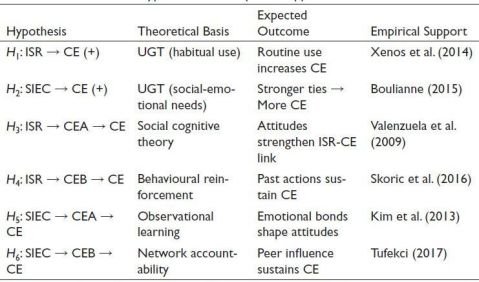
Overall, the literature on social media and CE suggests a complex relationship between the two, with both positive and negative impacts depending on various factors, such as age, education, political interest, and the broader political and social context. Besides, the mediating role of CEA and CEB, can be pivotal in understanding these complex dynamics. Based on the literature review, the research questions are translated into six specific hypotheses, as shown in Table 1, that will be tested empirically.
Based on the above hypotheses, a conceptual research model is depicted in Figure 1.
Table 1. Formulation of Hypotheses and Empirical Support.
Note: CE: Civic engagement; CEA: Civic engagement attitudes; CEB: Civic engagement behaviours; ISR: Integration into social routines; SIEC: Social integration and emotional connection; UGT: Uses and gratifications theory.
Figure 1. Proposed Research Model and Hypotheses

Methodology
Research Context: Why Working Women of Sikkim?
This study focuses on Sikkim, a state with one of India’s highest female labour force participation rates, that is, 68.6%,2 to examine how social media facilitates CE amid competing role demands. The choice of Sikkim as the research setting is deliberate and significant for several reasons. As one of India’s smallest states with a population of approximately 600,000, Sikkim presents unique sociocultural characteristics that influence CE patterns. The state’s matrilineal traditions in certain communities, combined with its high female workforce participation, create a distinctive context for examining gender dynamics in digital civic participation. Moreover, Sikkim’s rapid digital transformation, with internet penetration growing from 27% in 2011 to over 65% in 2023,1 provides an ideal setting to study emerging digital civic practices. Working women in Sikkim represent a critical demographic for several reasons. First, their high labour force participation suggests greater economic agency that may correlate with CE. Second, the time constraints they face from balancing work and family responsibilities make them particularly reliant on efficient forms of civic participation, with social media offering potentially ideal solutions. Third, their experiences can provide valuable insights for other regions undergoing similar social and digital transformations. These intersecting trends of SMU and civic participation, especially among working women, create a unique context where working women must navigate complex digital landscapes while balancing multiple social roles and responsibilities.
Measurement and Scales
In this study, the SMU is captured using an SMU integration scale developed by Jenkins-Guarnieri et al. (2013). It included two reflective constructs, namely SIEC and ISR, for assessing the working women’s perception of SMU. SIEC and ISR refer to the extent to which individuals feel connected to and involved in social networks and routines, respectively. Involvement of individuals in civic activities, that is, CE, can be reflected by CEA and CEB, like volunteering for community projects, attending a community meeting to discuss local community problems, donating items for their local neighbourhoods, and working for a social group in the community (Kim & Ball-Rokeach, 2006). CEA refers to an individual’s beliefs and values regarding CE and the importance of participating in civic activities. CEB refers to an individual’s actual involvement in civic activities such as volunteering, voting or participating in community events.
Constructs, Variables and Operational Definitions
SIEC
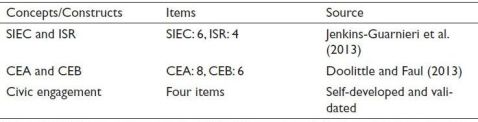
SIEC is represented by four items in this study. The construct is drawn out from the SMUIS, along with another variable, namely ISR (Jenkins-Guarnieri et al., 2013). SIEC originally consists of six items; however, items SIEC 1 and 5 have been removed due to poor factor loading. The items in SIEC describe the integration and emotional connection of individuals with social media and the people who use it. It consists of items such as I feel disconnected from friends when I have not logged into my social media accounts, and I get upset when I can’t log on to my social media accounts.
ISR
Similar to SIEC, ISR is also drawn out as a dimension from the SMUIS, and the items describe the engagement and frequency of use of social media. ISR is represented by four items and consists of items such as I enjoy checking my social media accounts and Using social media is a part of my everyday routine.
CEA
CEA is drawn out from a Civic Engagement Scale developed and validated by Doolittle and Faul (2013), consisting of two dimensions, that is, CEA and CEB. CEA consists of eight items and refers to the personal beliefs and feelings that people have about their involvement and their perceived ability to make a difference in the community. Three items, namely CEA 1, 5 and 7, have been removed from the scale due to poor factor loading in the construct.
CEB
CEB refers to the actions that people take to actively engage and make a difference in their community. CEB consists of six items. CEB 5 has been removed from the construct due to poor factor loadings.
CE.
CE in this study refers to the actual posts, information, updates, videos and others received over social media and actions taken by the people in reality for the betterment of society as a whole. It is an overall process of believing that one can make a difference in enhancing their community through social media. Initially, we included the six dimensions of CE, namely civic sense (such as being polite; showing consideration to the elderly and other needy people; not littering on streets, keeping public property clean; smoking only at designated places and others), social issues of public concern (such as poverty, inequalities, gender issues, illiteracy, public health, unemployment, bullying, people with a disabilities and others), environmental issues (such as stopping the use of plastic, switching to renewable energy resources, saving electricity and water, recycling waste, lowering consumerism, buying energy-saving and water-saving appliances, using chemical-free products, plantation and others), community volunteering activities (such as the organisation of blood donation camps and free medical camps, raising funds and resources during disasters, planting trees and teaching poor children free of charge), political participation (such as influence others, e.g., elected representatives and policy makers while they make decisions of public concern; protests, strikes, boycotts, online petitioning, e-campaigning, blogging and others), and protection of cultural heritage (such as tangible culture—buildings, monuments, landscapes, books, works of art and artefacts; intangible culture—folklore, traditions, language and knowledge) in our scale. But while checking reliability and validity, two dimensions, that is, environmental issues and protection of cultural heritage, were dropped due to poor results. Thus, four variables of CE related to civic sense, social issues of public concern, community volunteering and political participation were assessed on a 5-point Likert scale with anchors as 0: do not receive, 1: receive the information, 2: receive the information and share with others, 3: share with others and ask them to take action, 4: engage myself and ensure others participation for assessing the overall active or passive engagement in civic activities for the betterment of the community. Table 2 summarizes the sources of constructs and items included under each. The final results of reliability and validity of constructs and variables are shown in Table 3, Table 4, Table 5, Table 6 and Table 7.
Table 2. Constructs, Items and Sources of Scales.
Note: CEA: Civic engagement attitudes; CEB: Civic engagement behaviours; ISR: Integration into social routines; SIEC: Social integration and emotional connection.
Sampling Design
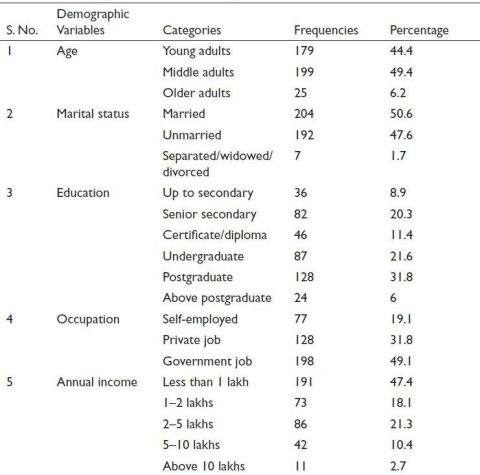
The study employs a quantitative research design to provide a comprehensive understanding of research questions and the testing of hypotheses. A structured survey was administered to 403 working women across Sikkim’s five districts, employing stratified sampling to ensure representation across urban and rural areas, different economic sectors, and age groups. The sample size of 403 working women was determined based on statistical considerations aimed at ensuring reliable and generalisable findings. The selection aligns with widely accepted practices in survey research, where a sample size of approximately 400 provides a 95% confidence level with a margin of error of about ±5% for a population proportion estimate. This level of precision is considered adequate for social science research, especially when drawing conclusions about patterns, behaviours or attitudes (Lakens, 2022). The survey measured all key constructs (ISR, SIEC, CEA, CEB and CE) using validated scales adapted to the local context. The demographic details of the sample are given in Table 3.
Table 3. Demographic Details of Working Women.
Tools for Data Analysis
This study employs partial least squares structural equation modelling (PLS-SEM) to analyse the complex mediation relationships between SMU (ISR/SIEC) and CE through attitudinal (CEA) and behavioural (CEB) mediators. Given our sample size of 403 working women in Sikkim, PLS-SEM is particularly appropriate as it performs robustly with smaller samples compared to covariance-based SEM (Hair et al., 2019). Besides, PLS-SEM does not assume multivariate normality, making it more suitable than traditional SEM approaches for analysing our data (Hair et al., 2019). This characteristic is particularly valuable when studying behavioural phenomena in natural settings, where perfectly normal distributions are uncommon (Ketchen, 2013).
Results and Findings
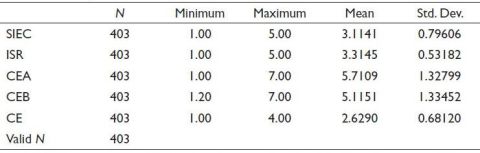
The descriptive statistics in Table 4 reveals several key patterns in the data: SIEC shows moderate engagement (M = 3.11, SD = 0.80), while ISR demonstrates slightly higher and more consistent incorporation into daily life (M = 3.31, SD = 0.53). Both CEA (CEA: M = 5.71, SD = 1.33) and CEB (CEB: M = 5.12, SD = 1.33) exhibit high means with substantial variability, though the lower behavioural scores suggest potential barriers in translating attitudes into action. The CE composite (CE: M = 2.63, SD = 0.68) indicates moderately positive participation levels. All constructs show good response variability without floor/ceiling effects. This implies that the ISR-CEA-CEB-CE progression aligns with Social Cognitive Theory’s emphasis on observational learning leading to attitudinal and behavioural change (Bandura, 1986). The moderate SIEC scores support role strain theory’s prediction of limited emotional bandwidth for working women (Goode, 1960). The high but variable CEA/CEB scores reflect UGT’s premise of diverse media gratifications (Katz et al., 1973)
Table 4. Descriptive Statistics for Constructs.
Note: CE: Civic engagement; CEA: Civic engagement attitudes; CEB: Civic engagement behaviours; ISR: Integration into social routines; SIEC: Social integration and emotional connection.
The correlation analysis in Table 5 reveals that while social media ISR and SIEC are moderately interrelated (r = .446, p < .01). However, their individual associations with CE components are relatively weak but statistically significant (ranging from r = .146 to .189, p < .01), suggesting that these digital behaviours contribute modestly to CEA and CEB. Notably, the strongest relationship emerges between CEA and CEB (r = .578, p < .01), indicating that positive civic attitudes are closely tied to actual participation, while both CEA (r = .260) and CEB (r = .217) show moderate but significant correlations with overall CE. Crucially, neither ISR nor SIEC demonstrates a meaningful direct correlation with CE (r = .056 and .063, respectively), reinforcing the path analysis findings that social media’s influence operates primarily through the mediation of attitudinal and behavioural factors rather than through direct effects, highlighting the importance of fostering both civic-minded perspectives and participatory habits to effectively translate digital engagement into meaningful civic action.
Table 5. Correlation Among Constructs of the Study.
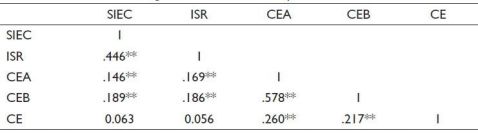
Notes: **Correlation is significant at the .01 level (2-tailed). CE: Civic engagement; CEA: Civic engagement attitudes; CEB: Civic engagement behaviours; ISR: Integration into social routines; SIEC: Social integration and emotional connection.
Measurement Model Evaluation
PLS-SEM was employed to assess both the measurement and structural models, as the framework is relatively complex, composed of both reflective and composite constructs (Ketchen, 2013). Initially, attention was focused on ensuring the reliability and validity of the reflective constructs (SIEC, ISR, CEA, CEB and CE). Next, the reliability and convergent validity of the reflective measurement models were assessed. Here, we considered the outer loadings of the items associated with each construct. Further, composite reliability (CR) and average variance extracted (AVE) were investigated. To establish reliability and convergent validity, the loadings, CR and AVE values should surpass 0.7, 0.7 and 0.5, respectively. Nonetheless, loadings between 0.5 and 0.7 remain acceptable if CR and AVE values reach the aforementioned threshold (Hair et al., 2019). Table 6 provides an overview of these results for all reflective constructs, demonstrating that reliability and convergent validity are established for the respondents.
Table 6. Reliability and Convergent Validity of Constructs.
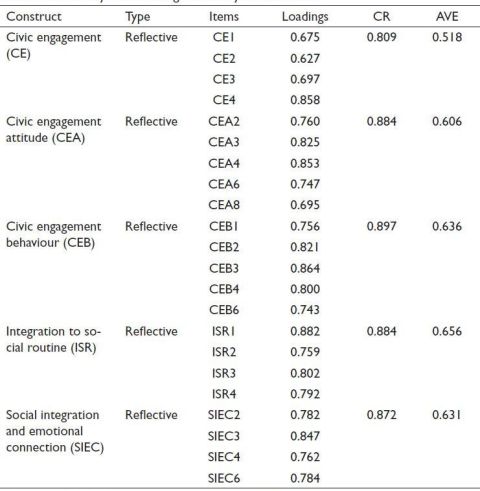
Note: AVE: Average variance extracted; CR: Composite reliability.
Following this, discriminant validity was examined and the results are shown in Table 7. Here, the Fornell–Larcker criterion and heterotrait-monotrait (HTMT) approaches were employed. Extant research suggests that acceptable HTMT values can be lower than either 0.85 or 0.9. Table 4 shows that discriminant validity was acceptable across the data. Further, as per Fornell and Larcker (1981), the results demonstrate that the square root of the AVE for each construct is greater than its correlation with all other constructs, again demonstrating discriminant validity.
Table 7. Discriminant Validity: Heterotrait-monotrait (HTMT) and (Fornell–Larcker).
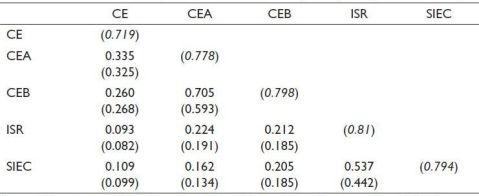
Notes: Values in parentheses show the results of discriminant validity as per Fornell–Larcker. CE: Civic engagement; CEA: Civic engagement attitudes; CEB: Civic engagement behaviours; ISR: Integration into social routines; SIEC: Social integration and emotional connection.
Structural Model Evaluation
Figure 2 shows the results of the hypothesis assessment for the sample data. The results highlight that the direct effect of SIEC and ISR on CE is not significant. However, results show a significant effect of SIEC on CEB, but not on CEA of working women. ISR is found to be significantly connected with CEA and CEB. Our results support that both CEA and CEB have a significant linkage with CE.
Figure 2. Path Coefficients and p Value.

Source: Output generated by authors using SmartPLS
Table 8. Testing of Hypotheses.
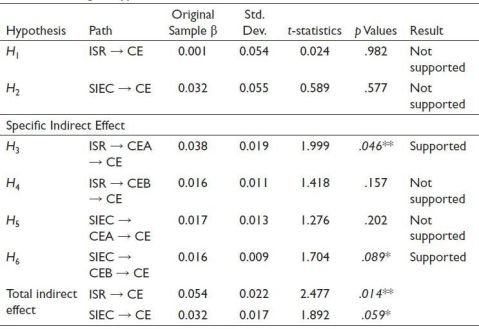
Notes: * and ** indicate the significance at 10% and 5% level of significance. CE: Civic engagement; CEA: Civic engagement attitudes; CEB: Civic engagement behaviours; ISR: Integration into social routines; SIEC: Social integration and emotional connection.
In order to assess mediation effects, we applied the product of coefficients approach (indirect effect), assessing the significance of indirect effects using bias-corrected bootstrap confidence intervals (CIs). Table 8 reveals that the direct effects of SIEC and ISR on CE (corresponding to hypotheses H1 and H2) are statistically insignificant. However, ISR exhibits a significant indirect effect on CE via CEA at the 5% level of significance (H3), and SIEC demonstrates a significant indirect effect on CE through CEB (H6) at the 10% level of significance. These findings provide empirical support for hypotheses H3 and H6, confirming the mediating role of CEA in the relationship between ISR and CE, and of CEB in the link between SIEC and CE.
The structural path analysis in Figure 2 reveals significant insights into how social media usage patterns (ISR and SIEC) influence CE through the mediating roles of CEA and CEB. There is a moderate positive effect of ISR (habitual SMU), and it significantly enhances CEA (β = 0.154, p < .05). This implies that the more frequently working women incorporate social media into daily life, the more likely they are to develop positive attitudes towards civic participation. ISR also has a modest but measurable impact on CEB (β = 0.129, p < .05), implying that habitual scrolling may lead to incidental exposure to civic content, prompting small-scale actions (e.g., sharing posts, signing petitions).
On the other hand, SIEC do not directly shape civic attitudes CEA (β = 0.068, p = .207). It means that, while emotional engagement fosters social bonding, it may not necessarily translate into civic-mindedness unless reinforced by informational exposure. The study confirms that SIEC in digital spaces significantly drives CEB (β = 0.128, p < .05). It simply means that strong social ties (e.g., WhatsApp groups, Facebook communities) motivate individuals to participate in civic activities due to peer influence and collective identity. While examining the mediating effects of CEA and CEB on CE, civic attitudes are the biggest predictor of actual engagement, as shown by the CEA .png) CE (β = 0.245, p < .001) path. CEB CE path has a small but significant effect (β = 0.123, p < .05), implying that the past civic actions reinforce future participation in line with behavioural reinforcement.
CE (β = 0.245, p < .001) path. CEB CE path has a small but significant effect (β = 0.123, p < .05), implying that the past civic actions reinforce future participation in line with behavioural reinforcement.
Discussion and Implications
The structural equation modelling results reveal nuanced pathways through which social media usage influences CE among working women in Sikkim, with findings both supporting and contradicting existing theoretical expectations. The complete rejection of direct effect hypotheses (H1 and H2) aligns with recent literature emphasising the mediated nature of digital participation (Boulianne, 2019), challenging earlier technological determinism that posited straightforward social media effects. The significant specific indirect effect supporting H3 (ISR CEA CE: β = 0.038, p < .05) confirms Bandura’s (1986) social cognitive theory, demonstrating how routine platform use cultivates civic attitudes that ultimately drive engagement—a pathway empirically validated in similar contexts by Valenzuela et al. (2009). However, the non-significant mediation through CEB in H4 contradicts portions of the habit formation literature (LaRose, 2010), suggesting that while routine use shapes attitudes, it may not automatically translate to participatory behaviours without additional motivational factors among working women.
The borderline significant mediation in H6 (SIEC CEB CE: β = 0.016, p < .10) partially supports role strain theory (Goode, 1960), indicating that emotional connections may help working women overcome participation barriers through behavioural channels, though the effect size remains modest. This finding echoes Vickery’s (2018) work on gendered digital networks, but questions the presumed strength of emotional ties in civic mobilisation (Tufekci, 2017). The non-significant H5 pathway (SIEC CEA CE) particularly challenges uses and gratifications assumptions about affective media experiences shaping civic orientations (Kim et al., 2013), suggesting that emotional connections operate more through behavioural than attitudinal routes in this population.
The significant total indirect effects (ISR CE: β = 0.054, p < .05; SIEC CE: β = 0.032, p < .10) collectively reinforce the ‘cognitive-first’ model of digital engagement, where attitudinal transformations precede behavioural changes. This pattern substantiates recent feminist revisions to CE theories (Schlesinger & Heldman, 2001) that account for gendered media appropriation strategies. However, the small effect sizes across all pathways suggest that digital platforms alone constitute insufficient conditions for robust civic participation, aligning with Schradie’s (2019) critique of technological solutionism. These results collectively highlight the need for more situated theorising that considers both platform affordances and the intersectional constraints facing working women in transitional economies.
Further analysis highlights the role of SIEC in shaping both CEA and CEB, with statistically significant path coefficients to CEA (β = 0.154, p < .05) and CEB (β = 0.128, p < .05). These findings confirm that emotional bonds and community integration positively influence civic disposition and action, aligning with Jenkins-Guarnieri et al. (2013). Conversely, ISR shows no direct effect on CEA (β = 0.001, p > .05), emphasising the need for additional psychosocial drivers. Prior literature (Feeney & Porumbescu, 2021; Morrow & Scorgie-Porter, 2017) supports this, indicating that social media catalyses CE primarily by enhancing attitudes and relational ties, rather than through habitual use alone. Contrasting findings by Bimber et al. (2012) further complicate the narrative, suggesting that, in the absence of emotional engagement, online routines may have limited participatory effects—highlighting the importance of context, demographic variables, and the nature of civic activities.
While SMU does not directly influence CEA or CEB, it exerts an indirect effect by strengthening SIEC, which subsequently fosters CE. This suggests that social media functions as an enabler—facilitating emotional connectivity that drives civic outcomes. As Quan-Haase et al. (2008) point out, social media’s role may be to modulate the intensity of participation rather than trigger it outright. Accordingly, institutions and policymakers aiming to enhance civic involvement should prioritise cultivating a sense of community through direct social contact—such as local meetings and personal outreach—where social media complements, rather than replaces, traditional engagement mechanisms.
Implications for Theory and Practice
The findings of this study offer several important theoretical implications that advance our understanding of CE, particularly for working women in non-Western contexts. First and foremost, the results challenge simplistic technological determinism by demonstrating that SMU does not directly lead to CE. Instead, the process is mediated through attitudinal and behavioural pathways, supporting more nuanced theoretical frameworks that emphasise the complex interplay between digital platforms and human agency. This aligns with recent critiques of direct effects models and reinforces the need to examine the psychological and social mechanisms that translate online activities into meaningful civic participation.
A key theoretical contribution emerges from the validation of sequential cognitive-behavioural pathways, as predicted by social cognitive theory. The strong mediation through CEA suggests that routine exposure to civic content on social media primarily works by shaping individuals’ perceptions and beliefs about participation before influencing actual behaviours. This finding has important implications for intervention design, highlighting the need to focus on content that cultivates civic-minded perspectives rather than simply encouraging superficial engagement metrics. The weaker behavioural pathways further emphasise that habitual platform use alone is insufficient to drive sustained civic action without accompanying attitudinal change.
The study also reveals important gendered dimensions in how different types of SMU affect CE. While routine use (ISR) significantly influences attitudes, SIEC primarily facilitates behavioural participation. This distinction supports role strain theory by showing how working women navigate civic participation within their constrained time budgets, using different platform features for different purposes. The findings suggest that emotional support networks may provide the necessary confidence boost for time-pressed women to translate their civic attitudes into action, even if they do not directly shape those attitudes.
Furthermore, the research challenges some universal assumptions in UGT by demonstrating contextual variations in how emotional connections relate to civic outcomes. In Sikkim’s unique sociocultural environment, SIEC appears to function more as a behavioural enabler than an attitudinal driver, possibly reflecting local patterns of gendered digital practice. This underscores the importance of developing regionally sensitive theories that account for how cultural norms and economic structures mediate technology’s social impacts.
Finally, the modest effect sizes across all pathways serve as an important reminder of digital media’s limitations in overcoming structural barriers to civic participation. While social media can facilitate certain forms of engagement, the small magnitudes suggest that it cannot compensate for systemic inequalities or replace robust civic infrastructure. This finding supports more critical perspectives on digital activism and cautions against technological solutionism, reinforcing the need for holistic approaches that combine platform-based strategies with institutional reforms addressing the root causes of participation gaps.
Limitations and Future Research Directions
The present study has certain limitations, which need to be addressed. However, this study is a novel attempt at identifying the aspect of CE among working women in hilly geography and contextual settings. But we envision many other promising areas in this field of study due to certain drawbacks in the evidence. First, the study used a cross-sectional design for data collection, which might not be sufficient for tracking the changing attitude of respondents towards CE by social media usage. There are possibilities of attitudinal changes by the usage of social media over a period of time, or with actual engagement in civic activities. Capturing this requires a longitudinal framework of data collection. Thus, more systematic research with longitudinal data collection and analysis could shed more light on many unfolded aspects of CE.
Second, differences in employment status of women, such as time and pressure at work, government versus private jobs, may also impact the usage of social media, which in turn may impact civic sense or participation. Geographical limitation of sampling is the third limitation of the study, adding more geographical units may bring forth new insights into the study and make generalisation possible. In this way, the study offers numerous directions for future researchers in terms of a longitudinal survey, geographical expansion, adding variables like employment status, gender, marital status, social norms, outcomes and many more. Apart from this, studies can also focus on the usage of different social media platforms and their influence on different types of CE activities.
Conclusion
This study provides compelling evidence that social media’s influence on CE among working women in Sikkim operates through mediated, rather than direct, pathways. While routine platform use (ISR) fosters civic attitudes (CEA) and emotional connections (SIEC) enable civic behaviours (CEB), neither dimension directly translates to overall CE without cognitive and behavioural mediation. The findings support Bandura’s (1986) Social Cognitive Theory, wherein attitudes (CEA) form first through exposure (ISR), behaviours (CEB) follow, influenced by both routine use (ISR) and emotional ties (SIEC). Final engagement (CE) depends on both attitudes and actions. Role strain theory explains gender-specific patterns, indicating that working women benefit from low-effort civic exposure (e.g., news feeds) due to time constraints. Emotional support networks help overcome participation barriers. In countries, where gender disparity can easily be observed in political, civil and social spheres, this study provides the basis and means for motivating half the population to actively participate and have their voice in local governance and management. The findings challenge universalist assumptions about digital participation, instead highlighting gendered, context-dependent mechanisms shaped by role strain, cultural norms and regional socio-economic factors.
The implications of these findings are multi-dimensional. For policymakers and civil society actors, the strongest predictor of CE—attitudinal change—points to the need for targeted civic education campaigns. Such efforts should promote narratives of collective efficacy and local governance participation, particularly in formats that resonate with women’s lived experiences. Moreover, since emotional engagement via private channels like WhatsApp proved effective in prompting civic behaviour, non-governmental organisations (NGOs) and advocacy groups should leverage these platforms to create safe, inclusive digital spaces. Time constraints faced by working women must also be addressed through low-effort engagement strategies such as micro-polls or voice note submissions, allowing for flexible yet meaningful participation.
For social media platform designers, the study advocates algorithmic interventions that prioritise civic content visibility, especially for users demonstrating habitual engagement patterns (high ISR). Features designed to enhance emotional connection—such as community recognition badges or moderated group discussions—could further reinforce SIEC and sustain civic involvement over time. Employers, too, have a role to play. Initiatives like paid ‘civic hours’ can reduce the conflict between professional duties and public participation, while digital literacy training within the workplace can expand women’s perception of social media beyond entertainment or networking towards civic use.
The research opens several avenues for future inquiry. Intersectional analyses that explore how caste, class or rural-urban divides shape digital civic pathways are essential. Comparing women across formal and informal work sectors could also illuminate economic barriers to engagement. Platform-specific studies—contrasting the effects of private (e.g., WhatsApp) versus public (e.g., Twitter/X) platforms or visual-first environments like Instagram—will help refine content strategies for different user bases. Longitudinal and experimental research can assess the long-term impact of attitude-driven civic actions and test behavioural nudges such as automated prompts or reminder notifications.
Acknowledgement
The authors acknowledge the contribution made by anonymous participants of the study.
Consent to Participate
Each participant has given informed consent. They were informed orally as well as in writing for voluntary participation. Respondents were ensured about the academic nature of the study and the anonymity of their responses.
Data Availability
Data can be made available on reasonable request.
Declaration of Conflicting Interests
The authors declared no potential conflicts of interest with respect to the research, authorship and/or publication of this article.
Funding
The authors disclosed receipt of the following financial support for the research, authorship and/or publication of this article: The authors, namely Dr Krishna Murari (Project Director) and Dr Shalini Shukla (Co-Project Director) are the awardees of the ICSSR Major Research Project. This research article is largely an outcome of the Research Project sponsored by the Indian Council of Social Science Research (ICSSR). However, the responsibility for the facts stated, opinions expressed, and the conclusions drawn is entirely that of the authors.
Notes
ORCID iDs
Krishna Murari https://orcid.org/0000-0003-4535-7153
Shalini Shukla https://orcid.org/0000-0002-4369-3527
Ahmed, A., & Gibreel, O. (2021). The role of social media in strengthening civic engagement in the Middle East and North Africa. World Journal of Entrepreneurship, Management and Sustainable Development, 17(3), 309–317. https://doi.org/10.1108/WJEMSD-02-2021-0020
Aldrich, D. P., & Meyer, M. A. (2015). Social capital and community resilience. American Behavioral Scientist, 59(2), 254–269. https://doi.org/10.1177/0002764214550299
Arora, P. (2019). The next billion users: Digital life beyond the West. Harvard University Press.
Bandura, A. (1986). Social foundations of thought and action: A social cognitive theory. In Prentice-Hall series in social learning theory (Vol. 16). Prentice-Hall.
Barnard, S. R. (2012). Digitally enabled social change: Activism in the internet age. New Media & Society, 14(5), 894–895. https://doi.org/10.1177/1461444812444415d
Berger, J., & Milkman, K. L. (2012). What makes online content viral? Journal of Marketing Research, 49(2), 192–205. https://doi.org/10.1509/jmr.10.0353
Bimber, B., Flanagin, A. J., & Stohl, C. (2012). Collective action in organizations: Interaction and engagement in an era of technological change. https://doi.org/10.1017/CBO9780511978777
Blais, A., & Achen, C. H. (2019). Civic duty and voter turnout. Political Behavior, 41(2), 473–497. https://doi.org/10.1007/s11109-018-9459-3
Bode, L. (2016). Political news in the news feed: Learning politics from social media. Mass Communication and Society. https://doi.org/10.1080/15205436.2015.1045149
Bond, R. M., Fariss, C. J., Jones, J. J., Kramer, A. D. I., Marlow, C., Settle, J. E., & Fowler, J. H. (2012). A 61-million-person experiment in social influence and political mobilization. Nature, 489(7415), 295–298. https://doi.org/10.1038/nature11421
Boulianne, S. (2015). Social media use and participation: A meta-analysis of current research. Information, Communication & Society, 18(5), 524–538. https://doi.org/10.1080/1369118X.2015.1008542
Boulianne, S. (2019). Revolution in the making? Social media effects across the globe. Information, Communication & Society, 22(1), 39–54. https://doi.org/10.1080/1369118X.2017.1353641
Centola, D. (2010). The spread of behavior in an online social network experiment. Science, 329(5996), 1194–1197. https://doi.org/10.1126/science.1185231
Doolittle, A., & Faul, A. C. (2013). Civic engagement scale: A validation study. SAGE Open, 3(3), 1–7. https://doi.org/10.1177/2158244013495542
Feeney, M. K., & Porumbescu, G. (2021). The limits of social media for public administration research and practice. Public Administration Review, 81(4), 787–792. https://doi.org/10.1111/puar.13276
Fletcher, R., & Nielsen, R. K. (2018). Are people incidentally exposed to news on social media? A comparative analysis. New Media and Society, 20(7), 2450–2468. https://doi.org/10.1177/1461444817724170
Fornell, C., & Larcker, D. F. (1981). Evaluating structural equation models with unobservable variables and measurement error. Journal of Marketing Research, 18(1), 39–50. https://doi.org/10.1177/002224378101800104
Gil de Zúñiga, H., Jung, N., & Valenzuela, S. (2012). Social media use for news and individuals’ social capital, civic engagement and political participation. Journal of Computer-Mediated Communication, 17(3), 319–336. https://doi.org/10.1111/j.1083-6101.2012.01574.x
Goode, W. J. (1960). A theory of role strain. American Sociological Review, 25(4), 483. https://doi.org/10.2307/2092933
Hair, J. F., Risher, J. J., Sarstedt, M., & Ringle, C. M. (2019). When to use and how to report the results of PLS-SEM. European Business Review, 31(1), 2–24. https://doi.org/10.1108/EBR-11-2018-0203
Harding, S. (Ed.). (2004). The feminist standpoint theory reader intellectual and political controversies. Routledge.
Hilbrecht, M., Shaw, S. M., Johnson, L. C., & Andrey, J. (2013). Remixing work, family and leisure: Teleworkers’ experiences of everyday life. New Technology, Work and Employment. https://doi.org/10.1111/ntwe.12010
Jenkins-Guarnieri, M. A., Wright, S. L., & Johnson, B. (2013). Development and validation of a social media use integration scale. Psychology of Popular Media Culture, 2(1), 38–50. https://doi.org/10.1037/a0030277
Katz, E., Blumler, J. G., & Gurevitch, M. (1973). Uses and gratifications research. Public Opinion Quarterly, 37(4), 509–523. https://doi.org/10.1086/268109
Ketchen, D. J. (2013). A primer on partial least squares structural equation modeling. Long Range Planning, 46(1–2), 184–185. https://doi.org/10.1016/j.lrp.2013.01.002
Kim, Y. C., & Ball-Rokeach, S. J. (2006). Civic engagement from a communication infrastructure perspective. Communication Theory, 16(2), 173–197. https://doi.org/10.1111/j.1468-2885.2006.00267.x
Kim, Y., Hsu, S. H., & Gil de Zúñiga, H. (2013). Influence of social media use on discussion network heterogeneity and civic engagement: The moderating role of personality traits. Journal of Communication, 63(3), 498–516. https://doi.org/10.1111/jcom.12034
Kim, Y., & Kim, B. (2022). Effects of young adults’ smartphone use for social media on communication network heterogeneity, social capital and civic engagement. Online Information Review, 46(3), 616–638. https://doi.org/10.1108/OIR-08-2020-0332
Lakens, D. (2022). Sample size justification. Collabra: Psychology, 8(1). https://doi.org/10.1525/collabra.33267
LaRose, R. (2010). The problem of media habits. Communication Theory, 20(2), 194–222. https://doi.org/10.1111/j.1468-2885.2010.01360.x
Morrow, E., & Scorgie-Porter, L. (2017). An analysis of Robert D. Putnam’s bowling alone: The collapse and revival of American community. Macat Library. https://doi.org/10.4324/9781912282319
Njeru, A. (2021). Role of social media on community mobilization. Journal of Public Relations, 1(1), 40–52. https://doi.org/10.47941/jpr.655
Quan-Haase, A., Wellman, B., Witte, J. C., & Hampton, K. N. (2008). Capitalizing on the net: Social contact, civic engagement, and sense of community. In The internet in everyday life (pp. 289–324). https://doi.org/10.1002/9780470774298.ch10
Schlesinger, M., & Heldman, C. (2001). Gender gap or gender gaps? New perspectives on support for government action and policies. Journal of Politics. https://doi.org/10.1111/0022-3816.00059
Schradie, J. (2019). The revolution that wasn’t: How digital activism favors conservatives. Harvard University Press. http://www.jstor.org/stable/j.ctvfxv9ww
Setiawan, A. A., Triyanto, & Muchtarom, M. (2021). Using a social media Facebook to develop civic engagement in Indonesia. Academic Journal of Interdisciplinary Studies, 10(2), 220–227. https://www.richtmann.org/journal/index.php/ajis/article/view/12430/12026
Shukla, S., & Murari, K. (2023). Understanding social media and civic engagement research nexus: A systematic literature review. International Journal of Research in Management, 5(1), 108–118. https://doi.org/10.33545/26648792.2023.v5.i1b.78
Siyal, N. A., & Brohi, A. M. (2022). Social media and political awareness. Benazir Research Journal of Humanities and Social Sciences, 2(1), 64–82.. https://brjhss.com/index.php/brjhss/article/view/42/22
Skoric, M. M., Zhu, Q., Goh, D., & Pang, N. (2016). Social media and citizen engagement: A meta-analytic review. New Media & Society, 18(9), 1817–1839. https://doi.org/10.1177/1461444815616221
Song, H., Gil de Zúñiga, H., & Boomgaarden, H. G. (2020). Social media news use and political cynicism: Differential pathways through “news finds me” perception. Mass Communication and Society, 23(1), 47–70. https://doi.org/10.1080/15205436.2019.1651867
Treré, E. (2018). Hybrid media activism: Ecologies, imaginaries, algorithms (1st ed.). Routledge. https://doi.org/10.4324/9781315438177
Tufekci, Z. (2017). Twitter and tear gas: The power and fragility of networked protest. Yale University Press.
Valenzuela, S., Park, N., & Kee, K. F. (2009). Is there social capital in a social network site?: Facebook use and college student’s life satisfaction, trust, and participation. Journal of Computer-Mediated Communication, 14(4), 875–901. https://doi.org/10.1111/j.1083-6101.2009.01474.x
Verba, S., Schlozman, K. L., & Brady, H. E. (1995). Voice and equality: Civic voluntarism in American politics. Harvard University Press. https://doi.org/10.2307/j.ctv1pnc1k7
Vickery, J. R. (2018). Worried about the wrong things: Youth, risk, and opportunity in the digital world. European Journal of Communication, 33(1), 108–109. https://doi.org/10.1177/0267323117753751
Vitak, J., Zube, P., Smock, A., Carr, C. T., Ellison, N., & Lampe, C. (2011). It’s complicated: Facebook users’ political participation in the 2008 election. Cyberpsychology, Behavior and Social Networking, 14(3), 107–114. https://doi.org/10.1089/cyber.2009.0226
Xenos, M., Vromen, A., & Loader, B. D. (2014). The great equalizer? Patterns of social media use and youth political engagement in three advanced democracies. Information Communication and Society, 17(2), 151–167. https://doi.org/10.1080/1369118X.2013.871318
