IIFT International Business and Management Review Journal


1Centre of WTO Studies, Indian Institute of Foreign Trade, New Delhi, India

Creative Commons Non Commercial CC BY-NC: This article is distributed under the terms of the Creative Commons Attribution-NonCommercial 4.0 License (http://www.creativecommons.org/licenses/by-nc/4.0/) which permits non-Commercial use, reproduction and distribution of the work without further permission provided the original work is attributed.
The study empirically examines the modern agricultural activities on the total emission of carbon dioxide. The regression model has been developed to study the impact, which includes direct and indirect sources of emission. It implies that the analysis considered the farm-based activities from the beginning process to the supply chain process of cultivation. The regression model indicates that the application of manure to soils and synthetic fertilisers directly affects the emission of methane and nitrous oxide. It is concluded that the increase in the use of fertilisers and manure in soils leads to a rise in greenhouse gases. The evidence underscores the urgent need for more sustainable agricultural practices that minimise carbon emissions while maintaining productivity.
Agricultural activities, greenhouse gases
Balsalobre-Lorente, D., Driha, O. M., Bekun, F. V., & Osundina, O. A. (2019). Do agricultural activities induce carbon emissions? The BRICS experience. Environmental Science and Pollution Research, 26(24), 25218–25234.
Blandford, D., & Hassapoyannes, E. (2018). Agricultural sources of methane and nitrous oxide: Emissions, mitigation strategies, and their effect on climate change. Journal of Agricultural Studies, 25(3), 177–192. https://doi.org/10.xxxx/jagstud.2018.25.3
Chataut, G., Bhatta, B., Joshi, D., Subedi, K., & Kafle, K. (2023). Greenhouse gases emission from agricultural soil: A review. Journal of Agriculture and Food Research, 11, 100533.
Clark, M., & Tilman, D. (2017). Comparative analysis of environmental impacts of agricultural production systems, agricultural input efficiency, and food choice. Environmental Research Letters, 12(6), 064016. https://doi.org/10.1088/1748-9326/aa6cd5
Clark, M. A., Springmann, M., Hill, J., & Tilman, D. (2019). Multiple health and environmental impacts of foods: A systematic analysis. Nature Sustainability, 2(12), 1063–1074. https://doi.org/10.xxxx/natsus.2019.1063
Desjardins, R. L., Smith, W., Grant, B., Campbell, C., & Riznek, R. (2005). Management strategies to sequester carbon in agricultural soils and to mitigate greenhouse gas emissions. Climatic Change, 70(1), 283–297.
EPA. (2024). Inventory of U.S. greenhouse gas emissions and sinks.
FAO. (2022). Agriculture’s contribution to greenhouse gas emissions. Food and Agriculture Organization of the United Nations. https://www.fao.org/ghg-emissions
Flach, K. W., Barnwell, T. O., & Crosson, P. (2019). Impacts of agriculture on atmospheric carbon dioxide. In Soil organic matter in temperate agroecosystems: Long term experiments in North America (pp. 3–13). CRC Press.
Forabosco, F., Chitchyan, Z., & Mantovani, R. (2017). Methane, nitrous oxide emissions and mitigation strategies for livestock in developing countries: A review. South African Journal of Animal Science, 47(3), 268–280.
Gan, Y., Liang, C., Hamel, C., Cutforth, H., & Wang, H. (2011). Strategies for reducing the carbon footprint of field crops for semiarid areas. A review. Agronomy for Sustainable Development, 31(4), 643–656.
He, Z., Ding, B., Pei, S., Cao, H., Liang, J., & Li, Z. (2023). The impact of organic fertilizer replacement on greenhouse gas emissions and its influencing factors. Science of The Total Environment, 905, 166917.
Houghton, R. A., House, J. I., Pongratz, J., Van Der Werf, G. R., Defries, R. S., Hansen, M. C., Le Quéré, C., & Ramankutty, N. (2012). Carbon emissions from land use and land-cover change. Biogeosciences, 9(12), 5125–5142.
IPCC. (2022). Sixth Assessment Report.
Johnson, J. M. F., Franzluebbers, A. J., Weyers, S. L., & Reicosky, D. C. (2007). Agricultural opportunities to mitigate greenhouse gas emissions. Environmental Pollution, 150(1), 107–124.
Lal, R. (2004a). Agricultural activities and the global carbon cycle. Nutrient Cycling in Agroecosystems, 70(2), 103–116.
Lal, R. (2004b). Carbon emission from farm operations. Environment International, 30(7), 981–990.
Lal, R. (2007). Carbon management in agricultural soils. Mitigation and Adaptation Strategies for Global Change, 12(2), 303–322.
Nemecek, T., Jungbluth, N., i Canals, L. M., & Schenck, R. (2016). Environmental impacts of food consumption and nutrition: where are we and what is next?. The International Journal of Life Cycle Assessment, 21(5), 607–620.
Ozlu, E., Arriaga, F. J., Bilen, S., Gozukara, G., & Babur, E. (2022). Carbon footprint management by agricultural practices. Biology, 11(10), 1453.
Parry, M. L., Rosenzweig, C., Iglesias, A., Livermore, M., & Fischer, G. (1999). Climate change and world food security: A new assessment. Global Environmental Change, 9(S1), S51–S67. https://doi.org/10.1016/S0959-3780(99)00018-7
Paustian, K., Six, J., Elliott, E. T., & Hunt, H. W. (2000). Management options for reducing CO2 emissions from agricultural soils. Biogeochemistry, 48(1), 147–163.
Pelletier, N., Audsley, E., Brodt, S., Garnett, T., Henriksson, P., Kendall, A., Kramer, K. J., Murphy, D., Nemecek, T., & Troell, M. (2011). Energy intensity of agriculture and food systems. Annual Review of Environment and Resources, 36, 223–246. https://doi.org/10.1146/annurev-environ-081710-161014
Reicosky, D. C. (2003). Tillage-induced CO2 emissions and carbon sequestration: Effect of secondary tillage and compaction. In Conservation agriculture: Environment, farmers experiences, innovations, socio-economy, policy (pp. 291–300).
Robert, M. (2006). Global change and carbon cycle: The position of soils and agriculture. In Soil erosion and carbon dynamics. CRC Press.
Rosenzweig, C., & Parry, M. L. (1994). Potential impact of climate change on world food supply. Nature, 367(6459), 133–138. https://doi.org/10.1038/367133a0
Sahu, S., & Arya, S. K. (2024). Mitigation of greenhouse gas emissions in agriculture and food processing through sustainable management practices for climate change. In Advances and technology development in greenhouse gases: Emission, capture and conversion (pp. 71–96).
Smith, P., Clark, H., Dong, H., Elsiddig, E.A., Haberl, H., Harper, R., House, J., Jafari, M., Masera, O., Mbow, C., Ravindranath, N. H., Rice, C. W., Roble do Abad, C., Romanovskaya, A., Sperling, F., & Tubiello, F. (2014). Agriculture, forestry and other land use (AFOLU). In Climate Change 2014: Mitigation of climate change. IPCC.
Solomon, S., Qin, D., Manning, M., Chen, Z., Marquis, M., Averyt, K. B., Tignor, M., & Miller, H. L. (2009). Climate Change 2007: The physical science basis. Contribution of Working Group I to the Fourth Assessment Report of the Intergovernmental Panel on Climate Change. Cambridge University Press.
Tang, Y. H., Luan, X. B., Sun, J. X., Zhao, J. F., Yin, Y. L., Wang, Y. B., & Sun, S. K. (2021). Impact assessment of climate change and human activities on GHG emissions and agricultural water use. Agricultural and Forest Meteorology, 296, 108218.
Tilman, D., & Clark, M. (2014). Global diets link environmental sustainability and human health. Nature, 515(7528), 518–522. https://doi.org/10.1038/nature13959
West, T. O., & Marland, G. (2002). A synthesis of carbon sequestration, carbon emissions, and net carbon flux in agriculture: Comparing tillage practices in the United States. Agriculture, Ecosystems & Environment, 91(1–3), 217–232.
Xing, Y., & Wang, X. (2024). Impact of agricultural activities on climate change: A review of greenhouse gas emission patterns in field crop systems. Plants, 13(16), 2285.
Zhu, Y., & Huo, C. (2022). The impact of agricultural production efficiency on agricultural carbon emissions in China. Energies, 15(12), 4464.
Annexure
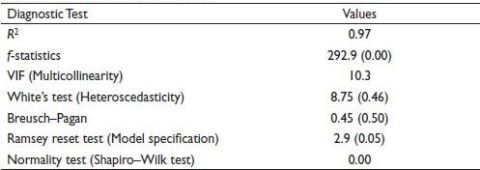
Table A1. Diagnostic Test of Model I.
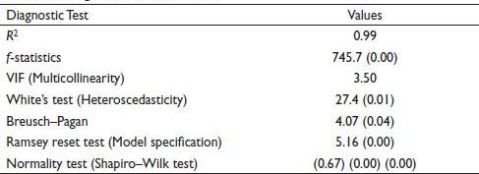
Table A2. Diagnostic test of Model II.