IIFT International Business and Management Review Journal


1Department of Finance, Faculty of Management and Finance, University of Colombo, Sri Lanka

Creative Commons Non Commercial CC BY-NC: This article is distributed under the terms of the Creative Commons Attribution-Non Commercial 4.0 License (http://www.creativecommons.org/licenses/by-nc/4.0/) which permits non-Commercial use, reproduction and distribution of the work without further permission provided the original work is attributed.
The life insurance industry is a cornerstone of the Sri Lankan financial system, driving economic growth through capital mobilisation and liquidity creation. Despite its importance, Sri Lanka exhibits a notably low life insurance penetration rate compared to other Asian countries. This study investigates the critical factors influencing the purchase behaviour of life insurance among individuals in Sri Lanka, filling a gap in localised empirical research. The research adopts a quantitative approach, utilising the Theory of Planned Behaviour and the Theory of Reasoned Action as its theoretical framework. Primary data were collected via structured questionnaires from a sample of 391 individuals across all 9 provinces of Sri Lanka. The study examines six independent variables: insurance literacy, attitude, subjective norms, trust, risk perception and perceived behavioural control, with purchase intention serving as the mediating variable. Data analysis was performed using multiple linear regressions and Baron and Kenny’s method to test the mediating impact. The results indicate that all six independent variables significantly influence life insurance purchase behaviour. Furthermore, purchase intention was found to partially mediate the relationship for insurance literacy, attitude, subjective norms and perceived behavioural control, while exerting a full mediation effect for trust and risk perception. The findings suggest that insurance companies and policymakers should prioritise enhancing life insurance literacy and building trust to increase penetration. Tailored marketing strategies focusing on young adults and educated segments are recommended to expand the market reach and strengthen social security in the country.
Life insurance, purchase behaviour, purchase intention, mediating impact, Sri Lanka
Ajzen, I. (1991). The theory of planned behavior. Organizational Behavior and Human Decision Processes, 50(2), 179–211.
Ajzen, I., & Madden, T. J. (1986). Prediction of goal-directed behavior: Attitudes, intentions, and perceived behavioral control. Journal of Experimental Social Psychology, 22(5), 453–474.
Alfiero, S., Battisti, E., & Ηadjielias, E. (2022). Black box technology, usage-based insurance, and prediction of purchase behavior: Evidence from the auto insurance sector. Technological Forecasting and Social Change, 183, 121896.
Aliyu, A. A., Bello, M. U., Kasim, R., & Martin, D. (2014). Positivist and non-positivist paradigm in social science research: Conflicting paradigms or perfect partners. Journal of Management and Sustainability, 4(3), 79.
Arun, T., Bendig, M., & Arun, S. (2012). Bequest motives and determinants of micro life insurance in Sri Lanka. World Development, 40(8), 1700–1711.
Atlas Magazine. (n.d.). Insurance penetration rate in Asia-Pacific. https://www.atlas-mag.net/en/category/tags/pays/insurance-penetration-rate-in-asia-pacific
Blunden, T., & Thirlwell, J. (2013). Mastering operational risk: A practical guide to understanding operational risk and how to manage it. Pearson UK.
Chaudhary, S., & Kaur, J. (2016). Consumer perception regarding life insurance policies: A factor analytical approach. Pacific Business Review International, 9(6), 52–61.
Chen, L., & Yang, X. (2018). Using EPPM to evaluate the effectiveness of fear appeal messages across different media outlets to increase the intention of breast self-examination among Chinese women. Health Communication, 34(11), 1369–1376.
Chen, Y. H., & Barnes, S. (2007). Initial trust and online buyer behaviour. Industrial Management & Data Systems, 107(1), 21–36.
Dodamgoda, N., & Canagasabey, D. (2019). Factors driving the purchase of life insurance among millennials in Sri Lanka. International Journal of Business Marketing and Management (IJBMM), 4(5), 49–61.
Echchabi, A., & Aziz, H. A. (2012a). Empirical investigation of customers’ perception and adoption towards Islamic banking services in Morocco. Middle-East Journal of Scientific Research, 12(6), 849–858.
Echchabi, A., & Aziz, H. A. (2012b). The relationship between religiosity and customers’ adoption of Islamic banking services in Morocco. Oman Chapter of Arabian Journal of Business and Management Review, 34(967), 1–6.
Farooq, M., Roman, M., Mohsin, N., Riaz, F., & Anwar, H. N. (2015). People’s attitude towards life insurance in Pakistan. Mediterranean Journal of Social Sciences, 6(3).
Fishbein, M., & Ajzen, I. (1975). Belief, attitude, intention, and behavior: An introduction to theory and research. Addison-Wesley.
Hasbullah, N. A., Osman, A., Abdullah, S., Salahuddin, S. N., Ramlee, N. F., & Soha, H. M. (2016). The relationship of attitude, subjective norm and website usability on consumer intention to purchase online: An evidence of Malaysian youth. Procedia Economics and Finance, 35, 493–502.
Insurance Regulatory Commission of Sri Lanka. (2022). Statistical review. https://ircsl.gov.lk/wp-content/uploads/2023/09/Statistical-Review-2022-final-15-09-2023.pdf
Jung, J., Shim, S. W., Jin, H. S., & Khang, H. (2016). Factors affecting attitudes and behavioural intention towards social networking advertising: A case of Facebook users in South Korea. International Journal of Advertising, 35(2), 248–265.
Lada, S., Harvey Tanakinjal, G., & Amin, H. (2009). Predicting intention to choose halal products using theory of reasoned action. International Journal of Islamic and Middle Eastern Finance and Management, 2(1), 66–76.
Ling, K. C., Chai, L. T., & Piew, T. H. (2010). The effects of shopping orientations, online trust and prior online purchase experience toward customers’ online purchase intention. International Business Research, 3(3), 63.
Luciano, E., Outreville, J. F., & Rossi, M. (2015). Life insurance demand: Evidence from Italian households; a micro-economic view and gender issue. SSRN Electronic Journal.
Mai, T., Nguyen, T., Vu, L., Bui, V., & Do, D. (2020). A study on behaviors of purchasing life insurance in Vietnam. Management Science Letters, 10(8), 1693–1700.
Masud, M. M., Ahsan, M. R., Ismail, N. A., & Rana, M. S. (2021). The underlying drivers of household purchase behaviour of life insurance. Society and Business Review, 16(3), 442–458.
Md Husin, M., & Ab Rahman, A. (2016). Predicting intention to participate in family takaful scheme using decomposed theory of planned behaviour. International Journal of Social Economics, 43(12), 1351–1366.
Md, N., Shahedul, A. S. M., & Md, F. R. (2017). Measuring people’s attitude towards the life insurance in Rangpur City Corporation in Bangladesh. International Journal of Economics &Management Sciences, 6(2).
Muda, M., Mohd, R., & Hassan, S. (2016). Online purchase behavior of generation Y in Malaysia. Procedia Economics and Finance, 37, 292–298.
Ofoghi, R., & Farsangi, R. H. (2013). The effect of insurance knowledge on the insurance demand: The case study of auto insurance. Technical Journal of Engineering and Applied Sciences, 3(23), 3356–3364.
Omar, O. E. (2007). The retailing of life insurance in Nigeria: An assessment of consumers’ attitudes. The Journal of Retail Marketing Management Research.
Panigrahi, S., Azizan, N. A., & Waris, M. (2018). Investigating the empirical relationship between service quality, trust, satisfaction, and intention of customers purchasing life insurance products. Indian Journal of Marketing, 1, 41–47.
Phau, I., Sequeira, M., & Dix, S. (2009). Consumers’ willingness to knowingly purchase counterfeit products. Direct Marketing: An International Journal, 3(4), 262–281.
Schoultz, C., Spetz, E., & Pettersson, I. (2022). Psychological factors impacting the consumer buying behavior: A study investigating how the psychological factors impact the cognitive decision-making process within the make-up industry [Bachelor’s thesis, Jönköping University].
Shih, Y. Y., & Fang, K. (2004). The use of a decomposed theory of planned behavior to study Internet banking in Taiwan. Internet Research, 14(3), 213–223.
Taylor, S., & Todd, P. A. (1995). Understanding information technology usage: A test of competing models. Information Systems Research, 6(2), 144–176.
Tennyson, S. (2011). Consumers' insurance literacy: Evidence from survey data. Financial Services Review, 20(3), 165–179.
Tingchi Liu, M., Brock, J. L., Cheng Shi, G., Chu, R., & Tseng, T. H. (2013). Perceived benefits, perceived risk, and trust: Influences on consumers’ group buying behaviour. Asia Pacific Journal of Marketing and Logistics, 25(2), 225–248.
Valentina-Daniela, C., & Gheorghe, O. (2015). Potential buyers’ attitude towards life insurance services. Procedia Economics and Finance, 32, 1083–1087.
Zou, H., & Adams, M. B. (2006). The corporate purchase of property insurance: Chinese evidence. Journal of Financial Intermediation, 15(2), 165–196.
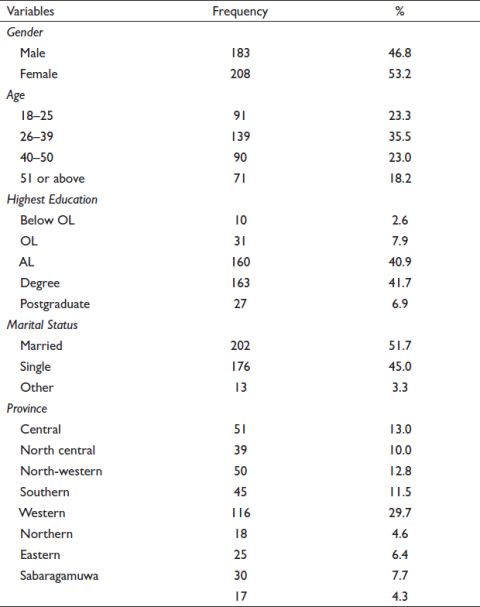
Annexure 1: Profile of the Respondents
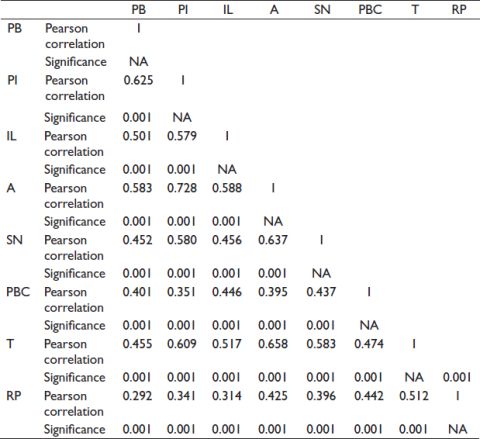
Annexure 2: Correlation Analysis
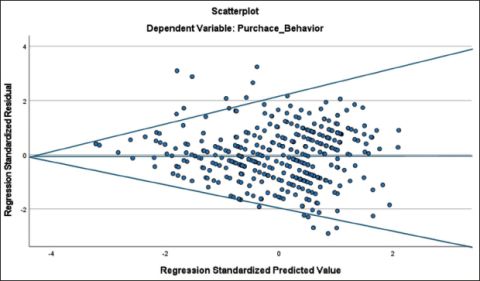
Annexure 3: Heteroscedasticity
Annexure 4: Serial Correlation

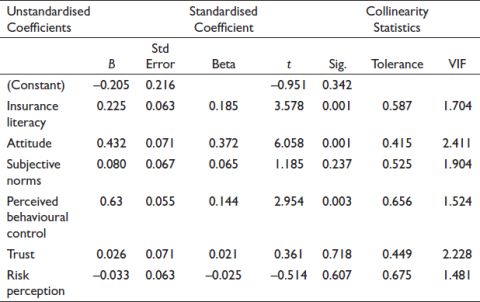
Annexure 5: Multicollinearity