
IIFT International Business and Management Review Journal


Ahamed Kabeer M1 
1Kuniya College of Arts and Science, Kannur University, Kannur, Kerala, India

Creative Commons Non Commercial CC BY-NC: This article is distributed under the terms of the Creative Commons Attribution-NonCommercial 4.0 License (http://www.creativecommons.org/licenses/by-nc/4.0/) which permits non-Commercial use, reproduction and distribution of the work without further permission provided the original work is attributed.
India is an agrarian economy, and products like spices and cashews are contributing a substantial amount to foreign earnings. India has the potential to offer goods at competitive prices not only in developed markets but also in developing markets around the world. The trade reforms and new economic scenario provide both opportunities and challenges in the world market. In this context, it is essential to examine which factors contribute to the export success of spices and cashews in the world market. The main objective of this chapter was to investigate the determinants of spices and cashew exports (CEs). The determinants of exports are identified as the exchange rate, domestic consumption, world demand and production. The study was carried out using the fully modified ordinary least squares (FMOLS) method. The augmented Dickey–Fuller (ADF) unit root test was used to test stationary, and the Johansen and Juselius cointegration test was used to examine long-run relationships among variables. All time series variables were integrated at order one. The Johansen cointegration test confirmed that there exists a long-run equilibrium relationship between variables. The FMOLS results reveal that variables like domestic consumption, exchange rate and production are the major determining factors for spice export. As far as aggregated CE is concerned, domestic consumption and exchange rate are the major determining factors during the study period.
Export, cashew, spices, world market, determinants
Introduction
India is an agrarian economy, and products like spices and cashews are contributing a substantial amount to foreign earnings. India has the potential to offer goods at competitive prices not only in the developed markets but also in developing markets around the world. Some of the determinants, such as Aggarwal (2002) manufacturing sector, Chadha (2009) health care industry, Ganguly (2007) iron and steel industry, Adhikari et al. (2016) agriculture sector, Khan (1990) spices industry (Wadkar et al., 2005). as focused on only a few variables, whereas present study considering both consumer and producer-level determinants.
The analysis of determinants was carried out at two levels. First, the determinants of exports are examined at the aggregated level for spices and cashews. The determinants of exports are identified as the exchange rate, domestic consumption, world demand and production. The selection of these regressors is theoretically consistent, as most studies on export have often identified the exchange rate, domestic consumption, world demand and production as key determinants of export performance. It is expected that the production and world export would have a positive impact on export, whereas domestic consumption and exchange rate would have a negative impact.
Empirical Model
For analysing the determinants of export performance of both spices and cashew, the following method has been estimated. The econometric specification, the fully modified ordinary least squares (FMOLS) method, is as follows

where ln represents the natural logarithmic transformation, .png) 0 is the intercept, P is production, WE is world export, DC is domestic consumption, ER is the exchange rate, and ut is the error term.
0 is the intercept, P is production, WE is world export, DC is domestic consumption, ER is the exchange rate, and ut is the error term.
Determinants of Spices and Cashew Export (CE) in India at Aggregated Level
The purpose of the analysis is to study the important variables that determine the spices and CE performance in India. For the purpose of analysis, the augmented Dickey–Fuller (ADF) unit root test is performed for stationary. The Johansen cointegration test is used for identifying the long-run relationship between exports and their determinants. The determinants of export performance are estimated through the FMOLS method. The variables are spices export (SE), CE, spices production (SP), cashew production (CP), spices world export (SWE), world cashew export (CWE), spices exchange rate (SER), cashew exchange rate (CER), spice domestic consumption (SDC), and cashew domestic consumption (CDS).
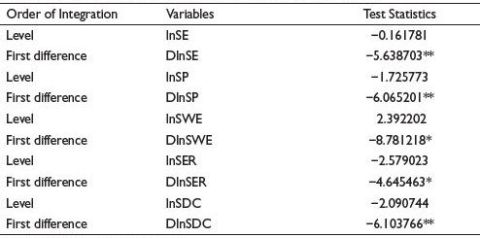
Table 1 shows the stationary test of the determinants variables for spices. At the level, all the variables are not stationary. Therefore, the researcher has taken the first difference. All variables are stationary at the first difference.
Table 1. Unit Root Test for Spices Augmented Dickey–Fuller (ADF).
Source: Estimation of the researcher.
Note: **Represents a stationary variable at 1% level of significance. *Denotes 5% level of significance. Dln: Variable differenced; ln: Natural logarithms of variables.
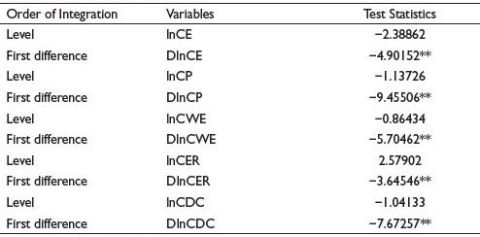
Table 2 shows the stationary test of the determinant variables for cashew. At the level, all the variables are not stationary. Therefore, the researcher has taken the first difference. All variables are stationary at the first order. The ADF test for the presence of a unit root indicates that variables are non-stationary at the level, whereas all the variables were integrated at order one.
Johansen and Juselius Cointegration for Spices and Cashew
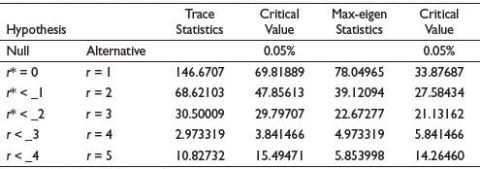
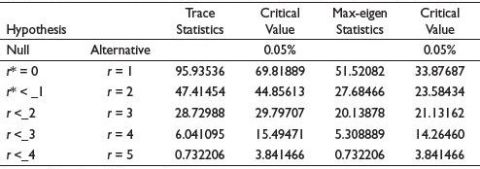
The method used for cointegration analysis is drawn from Johansen and Juselius cointegration test. The results from the cointegration test are presented in the following tables. If the trace statistics and the max-eigen statistics are higher than the critical value, it means there is a long-run relationship between the variables.
The unit root test shown in the table clearly indicates that time series variables are integrated at order one. The next step is to examine whether a long-run relationship exists between the variables, which are presented in Table 3 and Table 4, for spices and cashew, respectively. Therefore, in order to examine the long-run relationship between variables, cointegration analysis is employed. The data series are of the same order of integration, as suggested by the unit root test.
The researcher has estimated trace statistics and max-eigen statistics. The trace values and max-eigenvalues are higher than the critical value for three variables with respect to spices and two variables with respect to CE, which indicates that there is a long-run relationship among variables. It can also be inferred from the analysis that the independent variables have an impact on spices and CEs in India.
Table 2. Unit Root Test for Cashew.
Source: Estimation of the researcher.
Note: **Represents a stationary variable at 1% level of significance. *Denotes 5% level of significance. Dln: Variable differenced; ln: Natural logarithms of variables.
Table 3. Johansen and Juselius Cointegration Test for Export Determinants of Spices.
Source: Estimation of the researcher.
Note: *Indicates significant at 0.05% level.
Table 4. Johansen and Juselius Cointegration Test for Cashew Export Determinants.
Source: Estimation of the researcher.
Note: *Indicates significant at 5% level.
FMOLS Estimation
The cointegration test indicates the existence of a long-run relationship among the variables included in the econometric model. To identify the exact influencing variables, the researcher has estimated the FMOLS method.
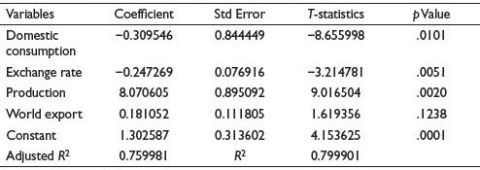
The result (Table 5) shows that variables like domestic consumption, exchange rate and production are the major determining factors for spice exports with a significance of 1%. The result shows that production has a positive influence on SE in India at a 1% level of significance, whereas the exchange rate and domestic consumption have statistically negative influences on SE. This implies that the increase in domestic consumption, declining production and the upward movement in the exchange rate adversely affect the performance of spice exports. Higher R2 (0.799901) indicates that the overall goodness of fit of the model is perfect.
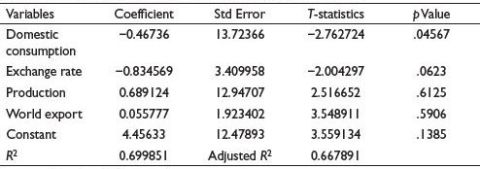
Table 6 shows that variables like domestic consumption and exchange rate are the major determining factors for CE. The result shows that the exchange rate and domestic consumption have a statistically negative influence on CE. This implies that the increase in domestic consumption and the upward movement in the exchange rate adversely affect the performance of CE. Higher R2 indicates that the overall goodness of fit of the model is perfect.
Table 5. Fully Modified Ordinary Least Squares Result of Spices.
Source: Estimation of the researcher.
Table 6. Fully Modified Ordinary Least Squares Result of Cashew.
Source: Estimation of the researcher.
Conclusion
The present study suggests that policymakers have to devise a strong strategy, keeping in mind the variables that influence the export of spices and cashews, in order to improve the export performance of these products in light of the above analysis.
Declaration of Conflicting Interests
The author declared no potential conflicts of interest regarding the research, authorship and/or publication of this article.
Funding
The author received no financial support for the research, authorship and/or publication of this article.
ORCID iD
Ahamed Kabeer M https://orcid.org/0009-0006-6264-0996
Adhikari, A., Sekhon, M. K., & Kaur, M. (2016). Export performance and determinants of rice from India. Journal of Agricultural Economics, 29(1), 23–30.
Aggarwal, A. (2002). Multinational enterprise and export performance evidence from Indian manufacturing. Development Studies, 38(3), 119–137.
Chadha, K. (2009). Product cycle innovation and export, a study of Indian pharmaceutical. World Development, 37(9), 1478–1483.
Ganguly, S. (2007). Export performance analysis of business groups, Indian iron and steel industry. International Business, 11(4), 40–50.
Khan, M. T. (1990). Indian pepper in the world market. Yojana, 34(12), 20–26.
Wadkar, Talathi, S., & Torance, S. (2005). Performance of cashew export from India. Journal of Agriculture Marketing, 12(7), 10–13.
